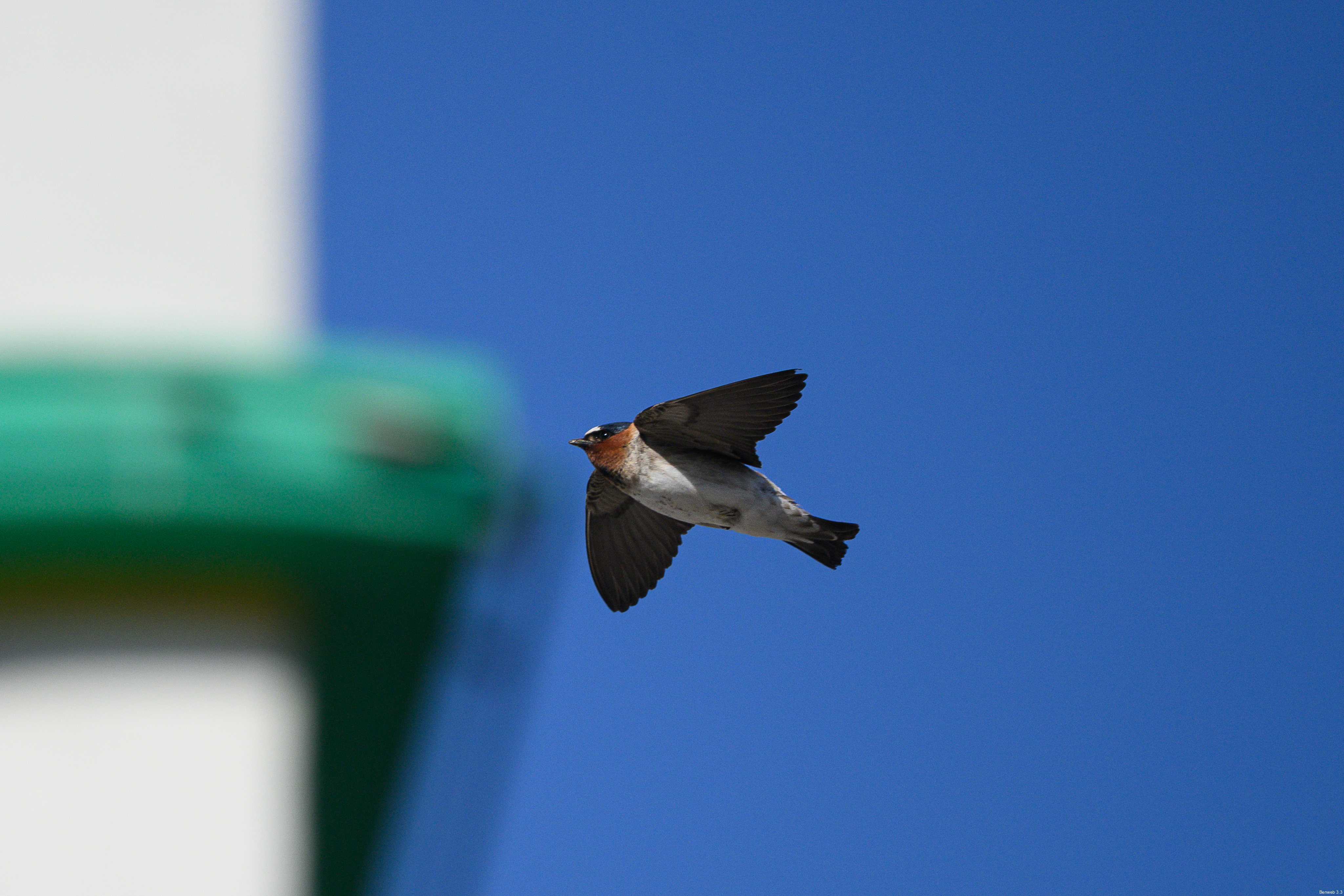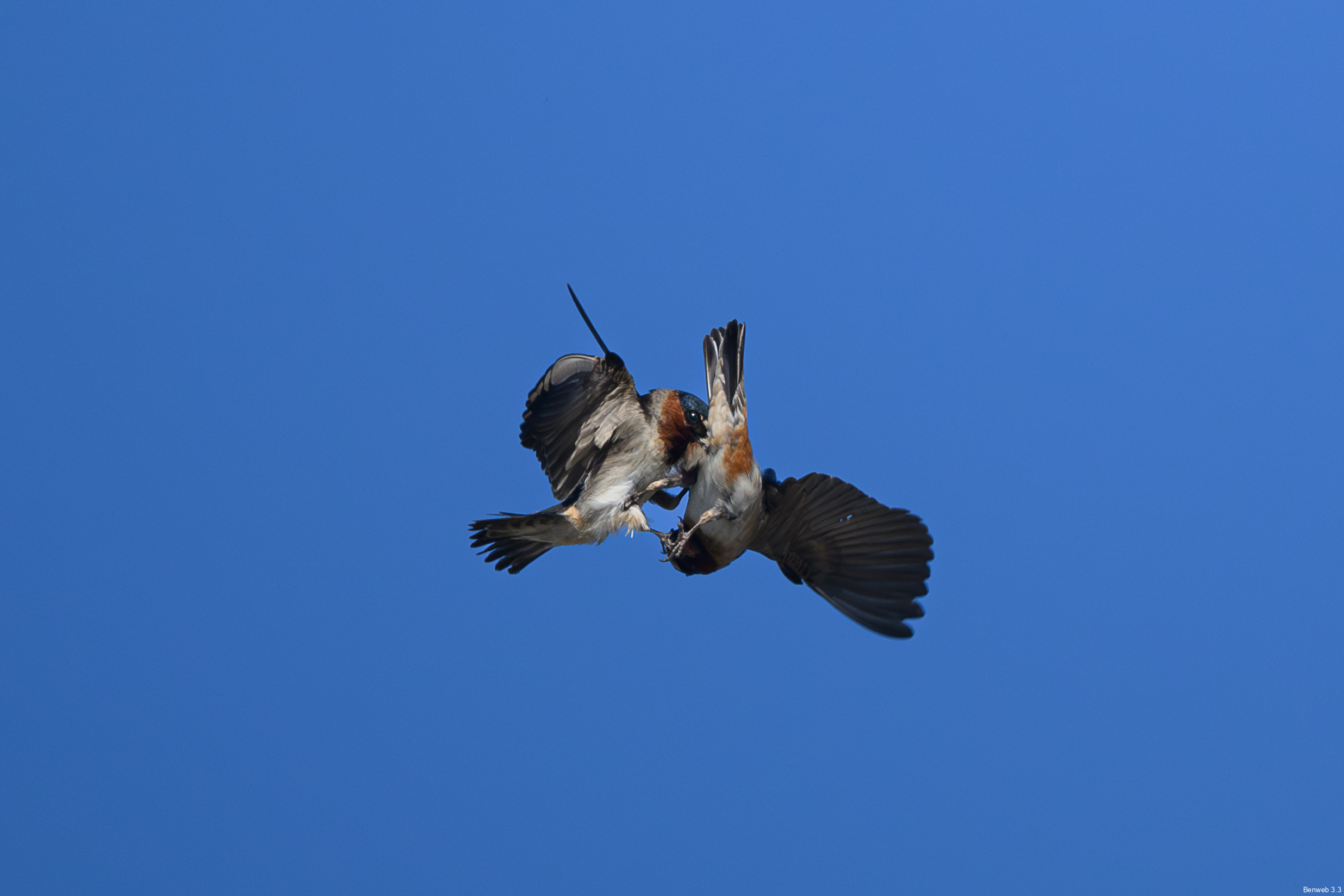
Cliff Swallows (Petrichelidon pyrrhonota) are sociable birds. They live together, they migrate together, they raise their young together. They nest in colonies that range from large (dozens to hundreds of birds) to very large (multiple thousands of pairs). Basically, when you see one Cliff Swallow, you’re likely to see dozens more.
Their ancestral range is right here in the west: they build their mud nests anywhere a steep cliff face meets an overhanging horizontal ledge. Historically, that meant they were at home in the foothills and steep canyons of the Sierra Nevada, the Cascades, and the Rocky Mountains. Over the past couple of centuries, though, as artificial cliffs with overhangs (think bridges, buildings with eaves, etc.) have proliferated from coast to coast, the swallows have expanded eastward across the Great Plains to nest across almost all of the United States.
The taxonomic name is interesting: the genus name already includes the entire common name! Petrichelidon, from petri, cliff, and khelidon, swallow, so, literally “cliff swallow.” Then the species designator, pyrrhonota means flame-backed (pyrrhos, flame-colored, red, and notos, -backed), which is a reasonable field mark for this swallow.
In winter, these flame-backed cliff-dwellers live in southern South America (Brazil, Paraguay, south-central Argentina, even as far south as Tierra del Fuego), meaning they migrate several thousand miles between breeding and wintering grounds. I’m not sure where they spend their time down there, but when they’re up on the breeding grounds, they spend a lot of it fairly conspicuously, in large flocks, doing what they do: feeding and breeding.
Theater-goers
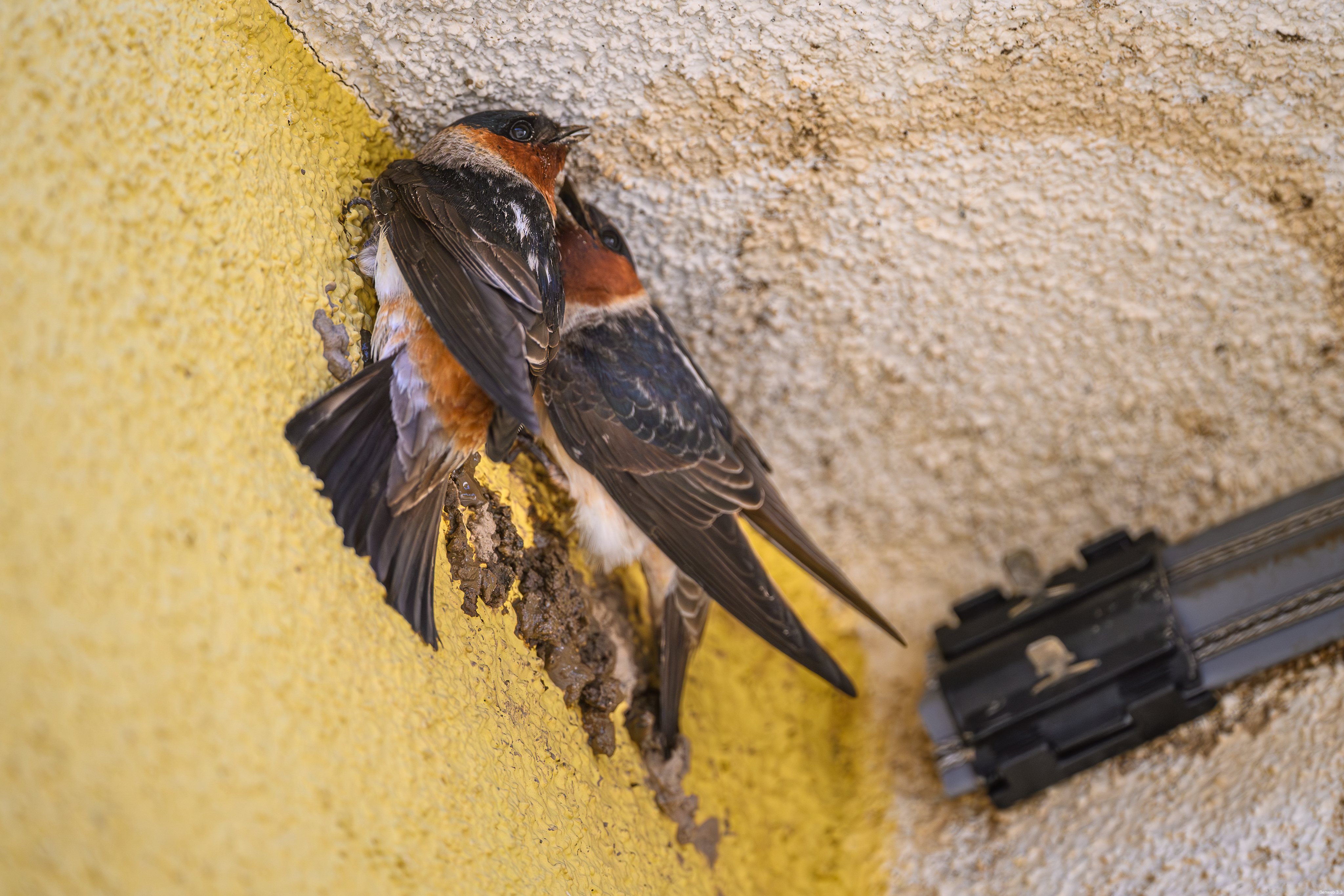
For at least the past several years, there’s been a colony of Cliff Swallows nesting on the side of the Atascadero Colony Cinema building in downtown Atascadero. The theater management cleans the nests off the sides of the building after the nesting season (it’s illegal to clean them off during nest building or nesting), but the colony’s swallows return every year and build them anew. (This is the bird made famous for its return to the mission in San Juan Capistrano, reputedly on March 19 every year, demonstrating the high degree of site fidelity displayed by this species.)
In general, Cliff Swallows at “small” colonies like the one at the Colony Cinema prefer to reuse nests year after year rather than start from scratch, but they apparently have strong enough site fidelity that even when faced with the necessity of building anew every year, they’ll do that rather than scout out a new colony site.
Unfortunately for the birds (but perhaps a relief for the theater management), despite a very high number of nest-building attempts at this site, only a few get built all the way. I think there’s just too much foot traffic for the birds, and thankfully, there are nest sites aplenty under nearby bridges. Here’s a shot of just one of the twelve columns of a bridge nearby.
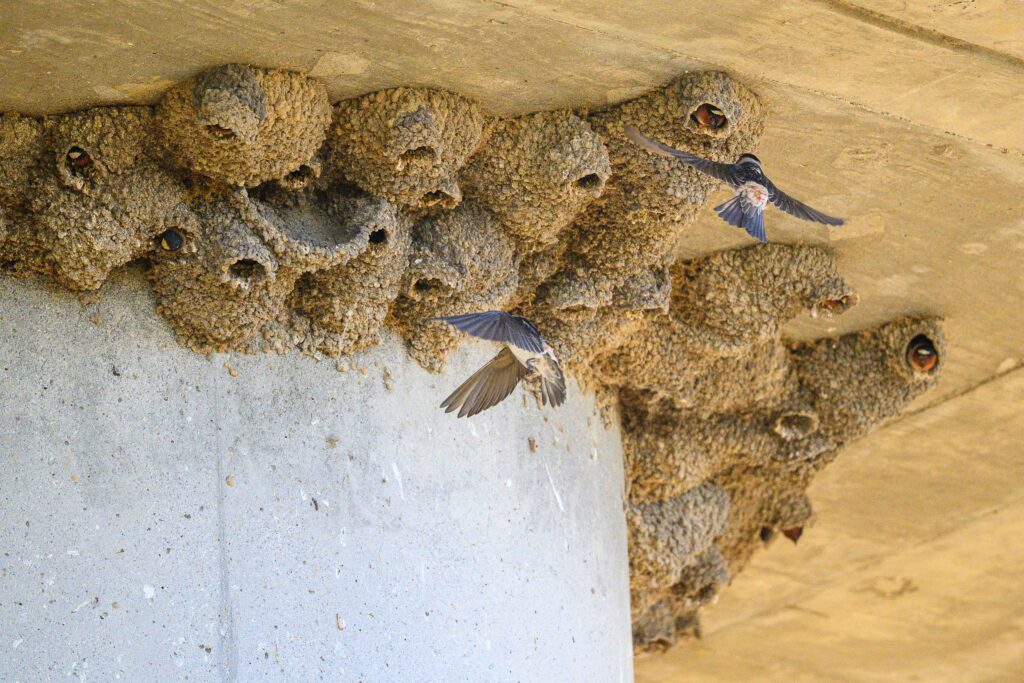
Extrapolating from the number of nests with openings we can see here (about 20, but some probably no longer usable, on the visible 25 percent of the column), there are at least seven hundred nests (60 x 12) at this one site. And I see similar aggregations at many of the bridges here in the AtascaRobles area.
Mud nests
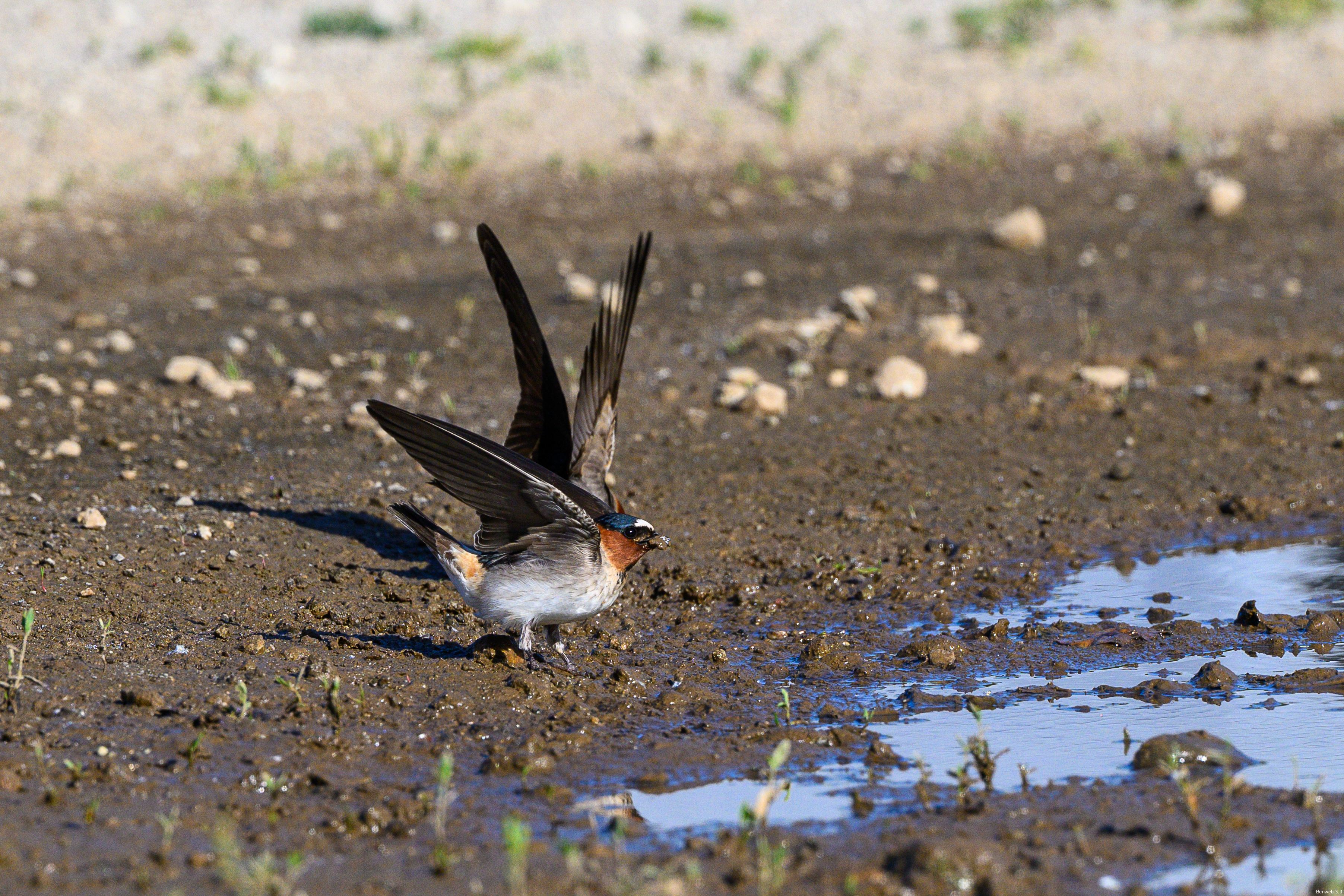
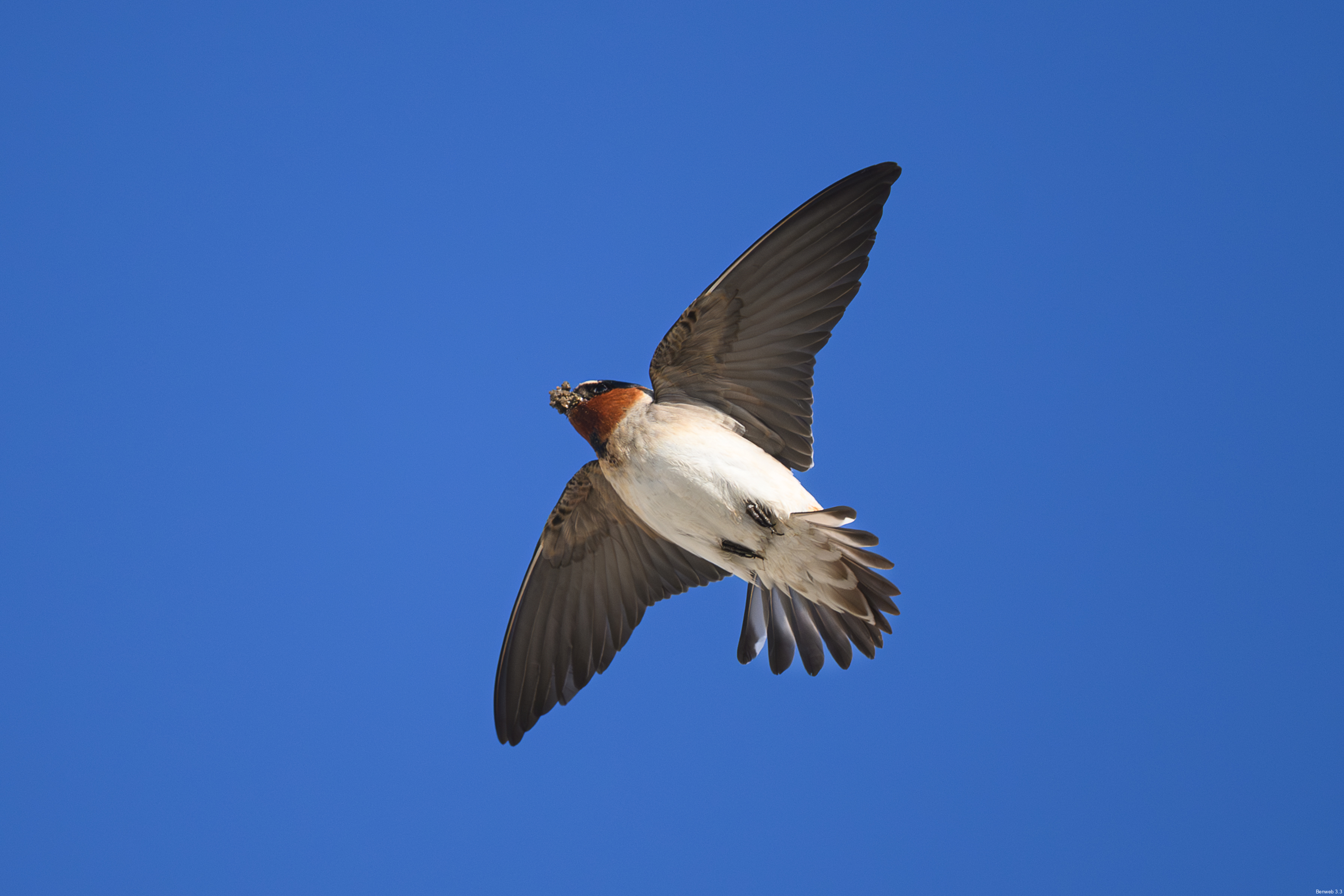
Cliff Swallows build their nests out of mud that they carry to their chosen substrate (bridge, building, cliff) one pellet at a time. It takes about 900 to 1,200 individual mud pellets to complete a nest. Both sexes build the nest, apparently, although how ornithologists figured this out is a mystery to me. (The birds are not sexually dimorphic, which means you can’t tell them apart visually unless a brooding female’s brood patch is visible.)
According to Birds of the World, the mud is applied thusly: “A bird brings a mud pellet back to the colony and molds it into the nest with a shaking motion of the bill. The shaking causes a partial liquefaction of the mud, disperses moisture, and allows fresh mud to overrun small air spaces, resulting in a stronger structure when dry.” Once the nest is about three-quarters complete, they start adding dry grass stems as lining inside.
The birds build collectively, because apparently having dozens of birds gathering mud at the same time makes life more efficient–the theory here is that all those birds together provides “vigilance advantages.” However, efficiency has its drawbacks: “A pair can bring as many as 44 mud pellets in a 30-min period, adding more than 1.5 cm to the nest rim during that time. If birds build too quickly, hunks of wet mud fall off before drying, which happens often.”
As I was observing the birds gathering mud at the permanently fenced-off dirt area across from the theater, I wondered why they held their wings up in the air and fluttered them. The answer lies in the mud itself: it’s a very sticky substance, as my clothes can attest whenever I encounter it. It turns out that the birds are most likely doing it to keep themselves clean. Here’s how the Birds of the World account describes it: “Wing-fluttering during mud-gathering may be to prevent extra-pair copulation attempts, but also probably keeps wet mud from soiling the wing and tail feathers.”
Flocking behavior
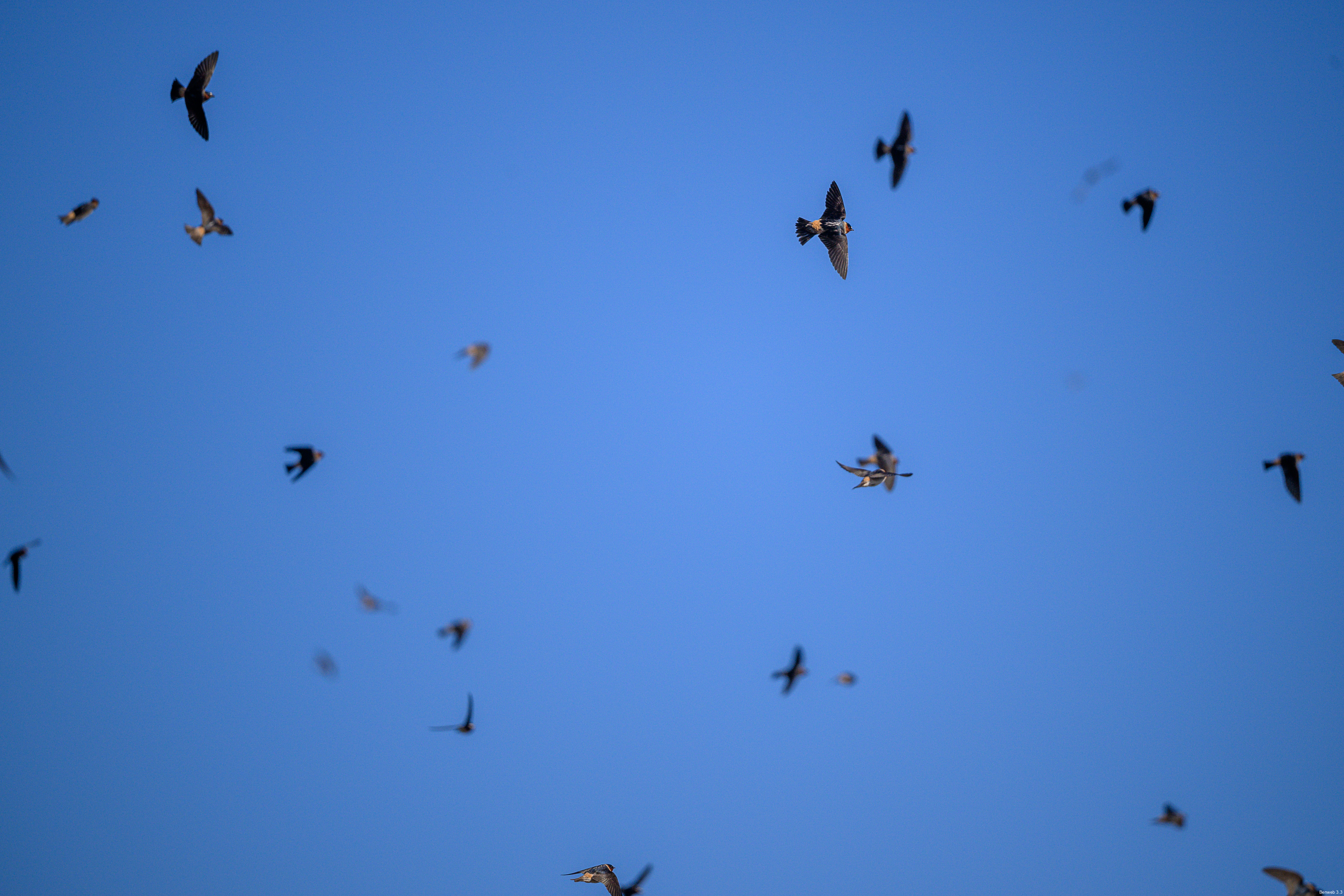
Even at a small colony like this, the number of birds in the air at any given moment can be astonishing. Trying to isolate individual birds for a good flight shot served as an object lesson in how flocking behavior deters predation. My camera’s autofocus is almost s-tier, but it kept being distracted by the number of birds in close proximity to my targeted one. I’m sure falcons and other aerial predators find it similarly challenging.
Many mornings at nearby Atascadero Lake, I’ll see the flock feeding out in the middle. Unlike the other swallows that nest nearby (Violet-greens and Tree), I rarely find them along the edges.
Here’s a little photo gallery of an early morning in early April at the Colony. Enjoy!