A haunting call echoes across the valley, rising from the surface of the still lake as the early morning sun peeks out from behind the surrounding hills. A large-bodied dark bird emerges out of the mist, tilts its head back, opens its beak, and begins to call again. If you’re like me, you’re probably imagining the iconic mating call of the Common Loon, with its eerie wails and yodels ringing out over some northern lake in late spring. But no, not here.
We’re on California’s central coast, and instead of the mating wail of the common loon, we have the “harsh, rolling cree creet” (as the authors of the species account in Birds of the World put it) of the Western Grebe (or the single-note cree of the closely related Clark’s Grebe). Like the wails and cries of the loon, though, these are the advertising calls of a water bird hoping to attract a mate. They sound out frequently in the winter months here on Santa Margarita Lake, and earlier in February I headed out there to try to hear and see it in action.
The lake was made back in 1941, when the army built a dam across the Salinas River a few miles southeast of the town of Santa Margarita:
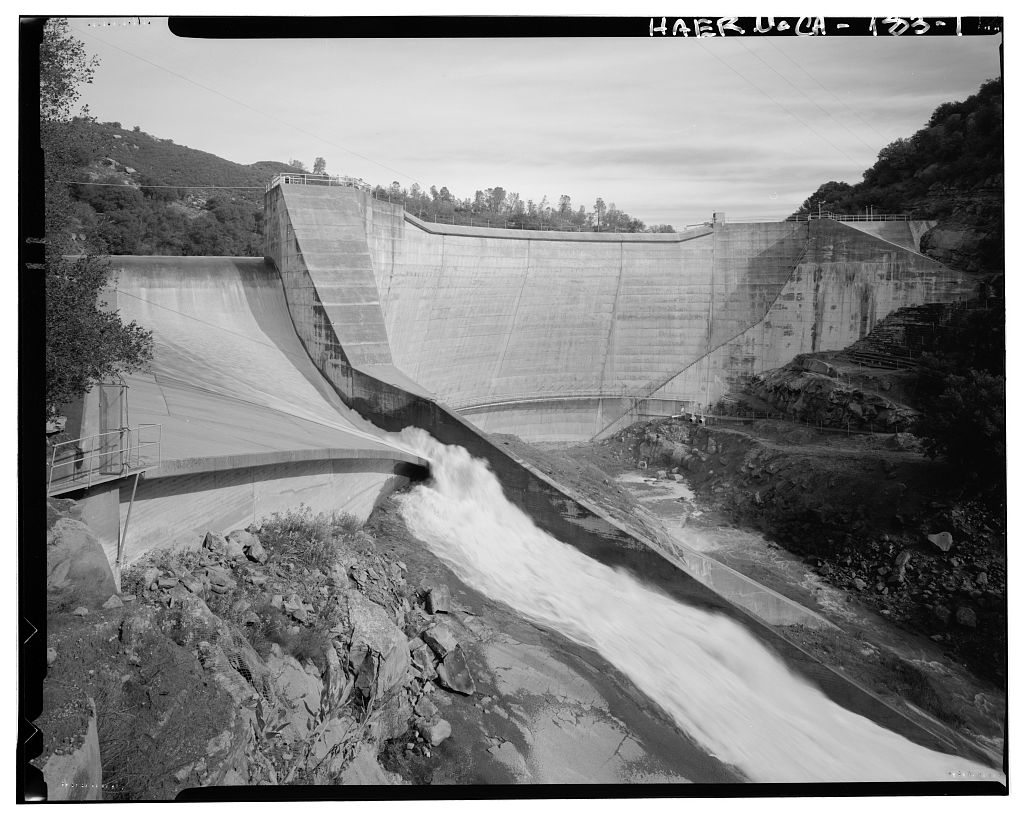
The dam was built in order to create a reservoir to supply water for the army at Camp San Luis Obispo, way over on the other side of the mountains. (The water was meant to travel via the Cuesta Tunnel, which was also custom built by the army for that purpose.) But, in classic army style, it turned out that the camp’s own wells provided enough water, so the reservoir was never needed or even used for its original purpose. It’s now part of the water supply both for local agriculture and for the city of San Luis Obispo.
Whatever its origins, Santa Margarita Lake now attracts humans and animals alike to the great fishing along its seven-mile length (with twenty-two miles of shoreline, quite a chore to circumnavigate!).
Particularly noteworthy year-round, but especially in winter on the lake are the scores of pairs of grebes (the Westerns outnumber the Clarks perhaps 4 or 5 to 1, by my guesstimate). And if you know anything about this closely related species pair, it’s not those harsh advertising calls but their astonishing courtship ritual runs and dances, that account for the appeal of these birds in the minds of many. These mating activities start off (at least here) as early as January and continue through February. (I’m not sure how many birds here are wintering birds vs residents, but the lake is large, and in the summer there are an awful lot of grebelets.)
Here’s how the article in Birds of the World describes these courtship rituals:
Western Grebe and Clark’s Grebe are perhaps best known for their elaborate and energetic courtship rituals. These courtship ceremonies—in which courting pairs perform a series of displays in ritualized, apparently mechanical, sequences—are among the most complex known in birds. [They have] two courtship ceremonies: “Rushing Ceremony” includes Advertising, Ratchet-pointing, Dip-shaking, Rushing, and diving; “Weed Ceremony” includes Neck-stretching, Bob-shaking, Weed-diving, Weed-dancing, Bob-preening, and Arch-clucking.
Despite the many sub-elements involved in each broad behavior, the two types of breeding ritual boil down to rushing, where they rise up vertically out of the water and run across the surface at top speed, presumably a test of fitness and compatibility, and the weed ceremony, where they again rise up vertically but this time in a stately, slow-motion dance of approach and retreat while carrying weeds from the lake bottom in their bills. Rushing reminds me of speed skating in all its frenzy, while the weed-dancing reminds me of figure skating or ballroom dancing with the added excitement of the birds offering up samples of home furnishings for inspection.
Before a grebe can start rushing or weed-dancing, though, it has to attract a potential mate–which is what that “harsh cree creet” call mentioned earlier is for. It rings out over surprisingly long distances at the lake; I’ve heard it echoing from any number of other little coves and inlets while there’s nary a grebe in close view.
A successful advertising call will bring more than one potential mate to the vicinity, and it seems that when this happens, a bit of sorting out takes place. Even though it’s a bit harder for human observers, the male and female grebes presumably can tell at a glance who’s who, and (usually) the Clark’s and the Westerns figure out which is which as well. (For nearly a century Western Grebes were treated as the same species as Clark’s Grebe, with the Clark’s being considered a “white morph” of the Western. The species do hybridize, though some authorities say it happens rarely, while others say it happens far more frequently than is documented.)
Beginning birders, or even advanced birders with limited experience of the species might take a bit longer to sort them out than the birds themselves take: Clark’s has a more colorful orange bill than the yellow-green bill of the Western; during the breeding season especially (but often visible year round) it has a little more white in the eye; and it has a bit paler body overall. (I use that last character with caution; it seemed that every “pale” grebe I noticed on these trips turned out to be Western rather than Clark’s.)
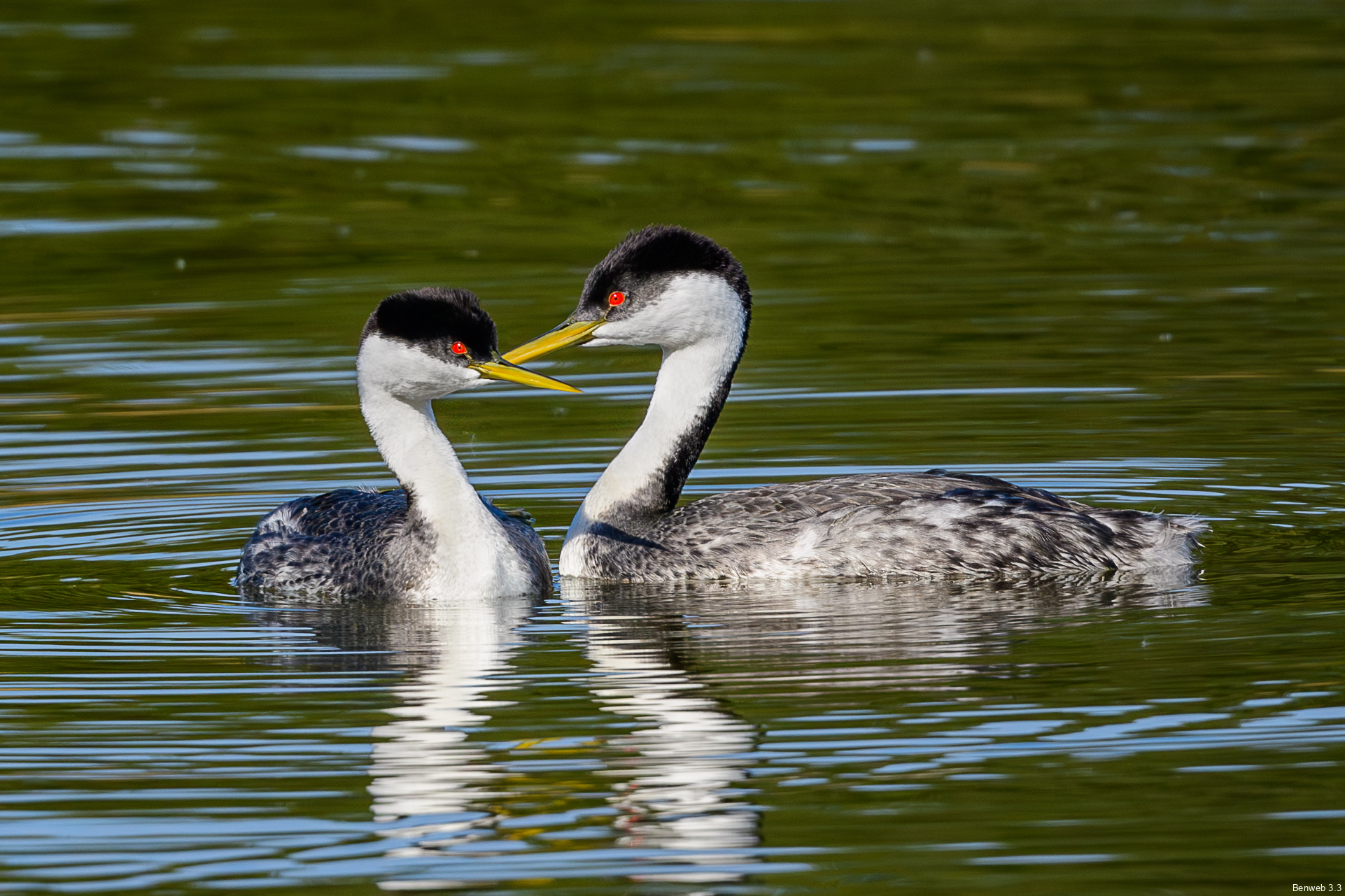
You can often see both species of grebe, along with the pied-bill grebe, a fair variety of ducks, and the omnipresent American Coot at a little bay near Mackey Point on the western half of the lake, just around the corner from the marina. Mackey Point is convenient for birds and observers alike: there’s a parking lot and a lakeside trail, both of which are lined by vegetation (shrubs on the dry land and a fairly tall bed of rushes and cattails in the littoral zone) that helps screen the humans and birds from each other’s sight.
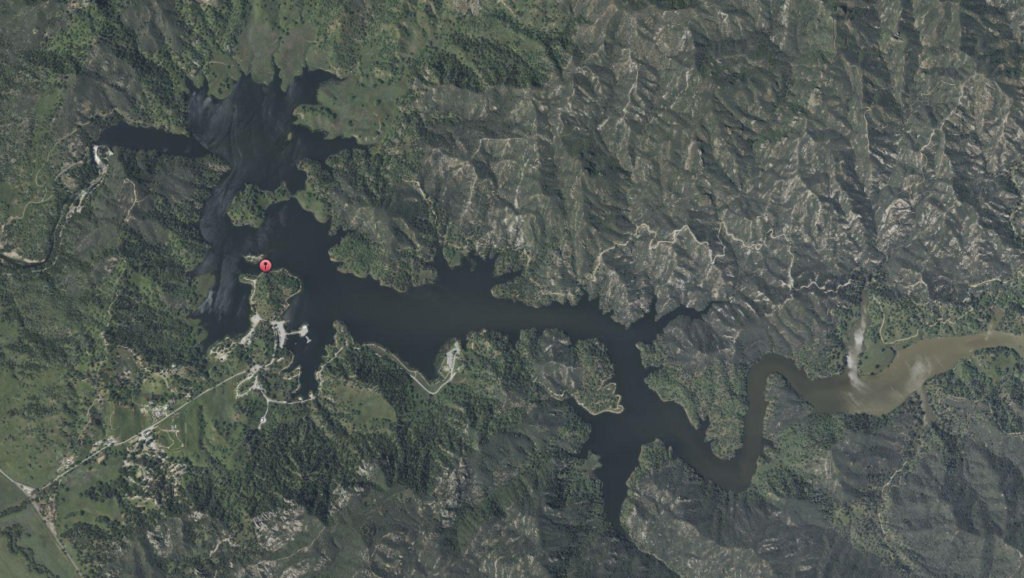
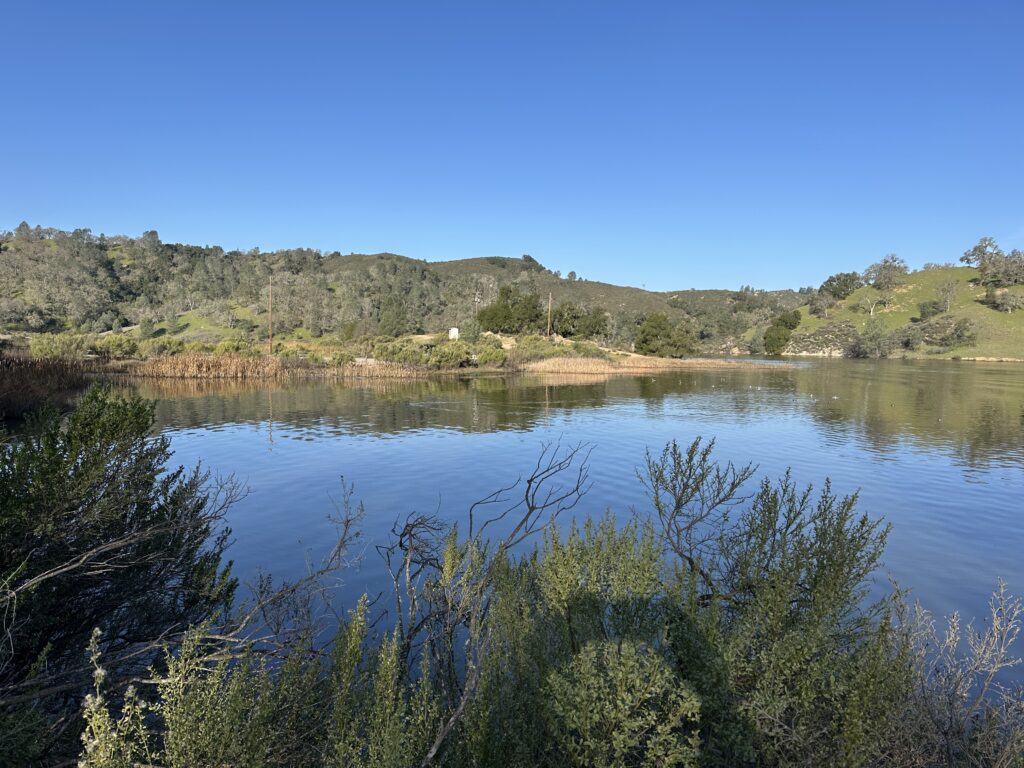
This natural blind allows for some fairly extended observing sessions without putting too much pressure on the birds. And when the birds are able to relax, it’s possible to get a decent look at their normal behaviors.
Rushing
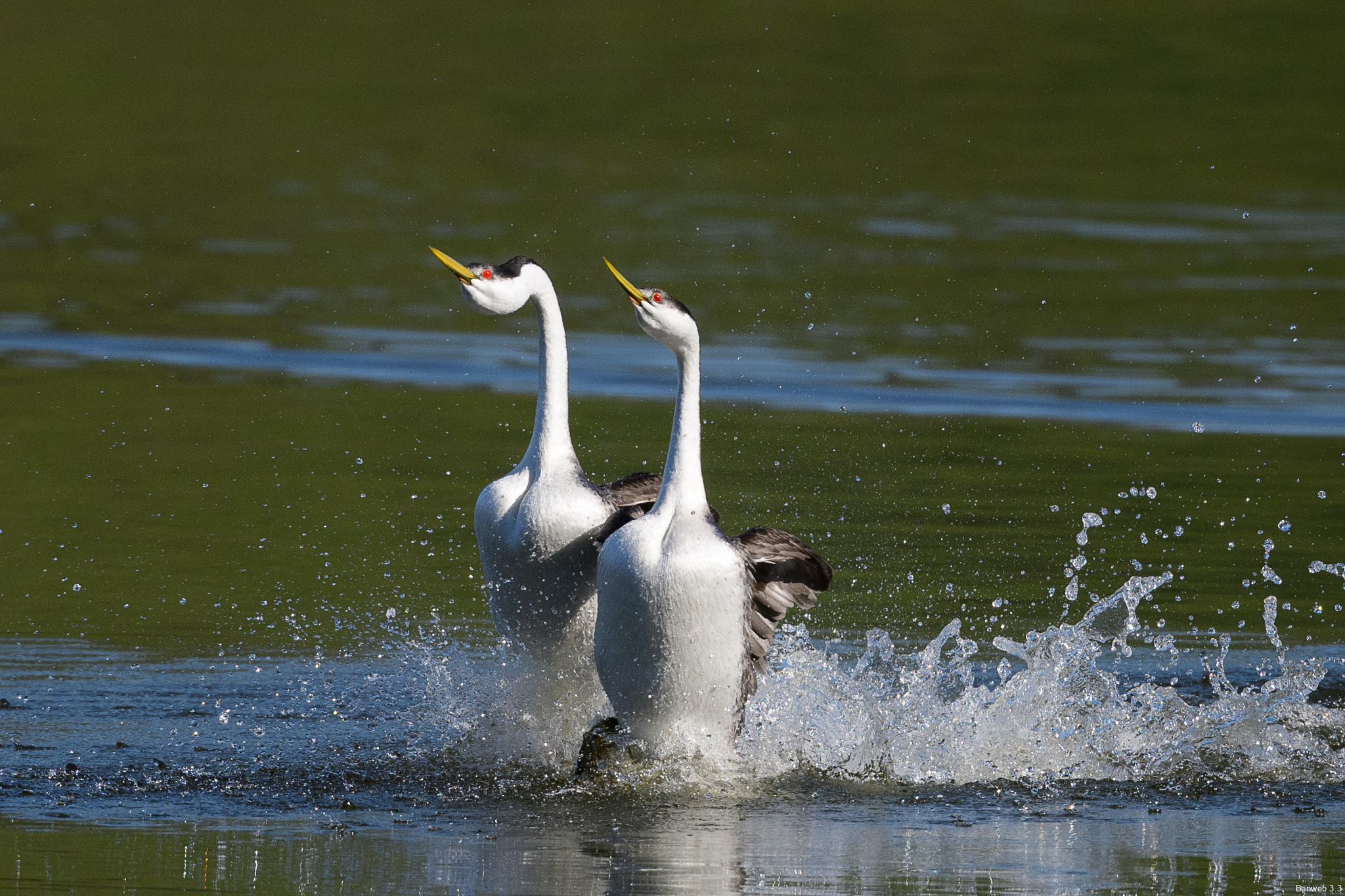
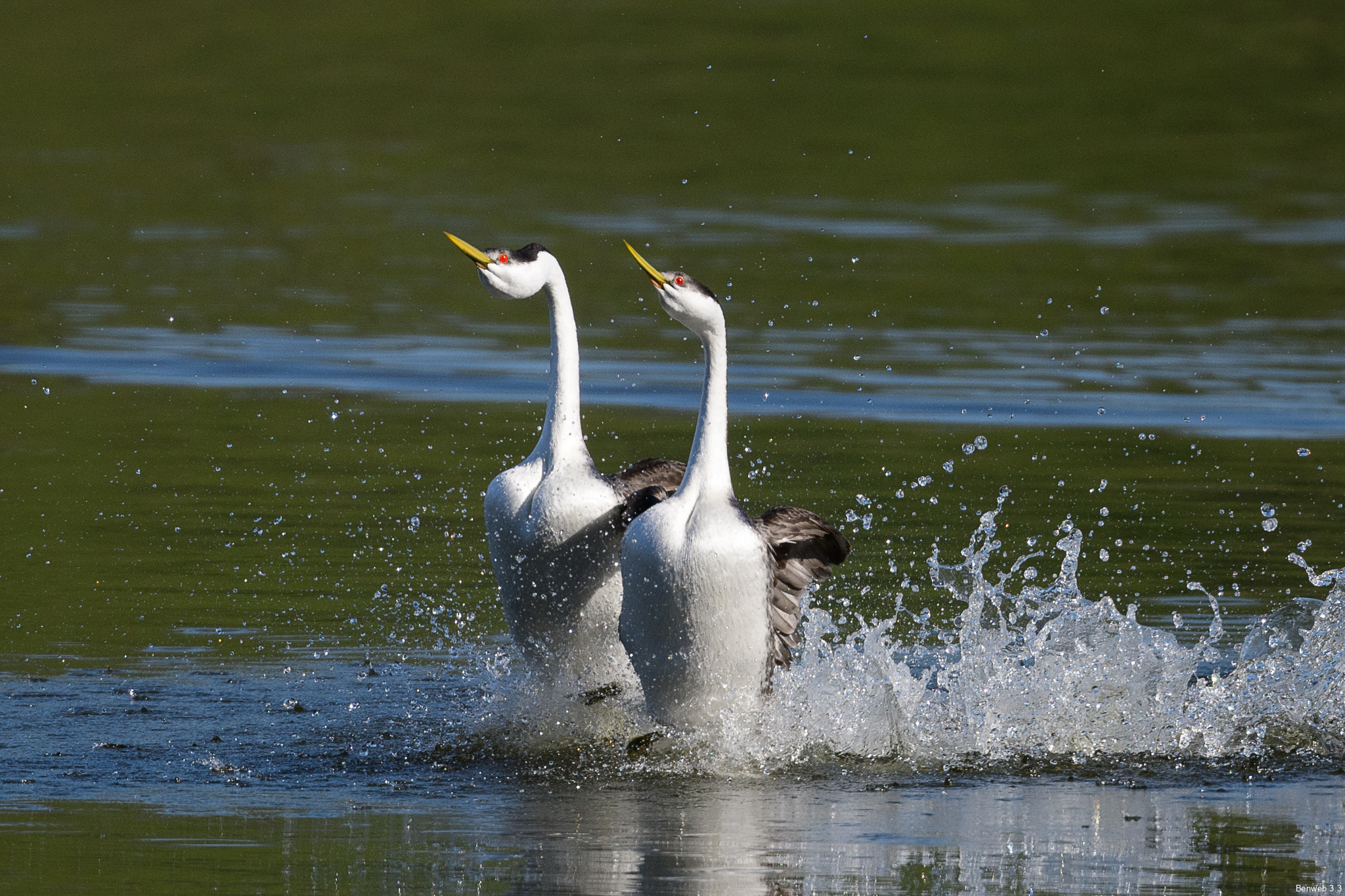
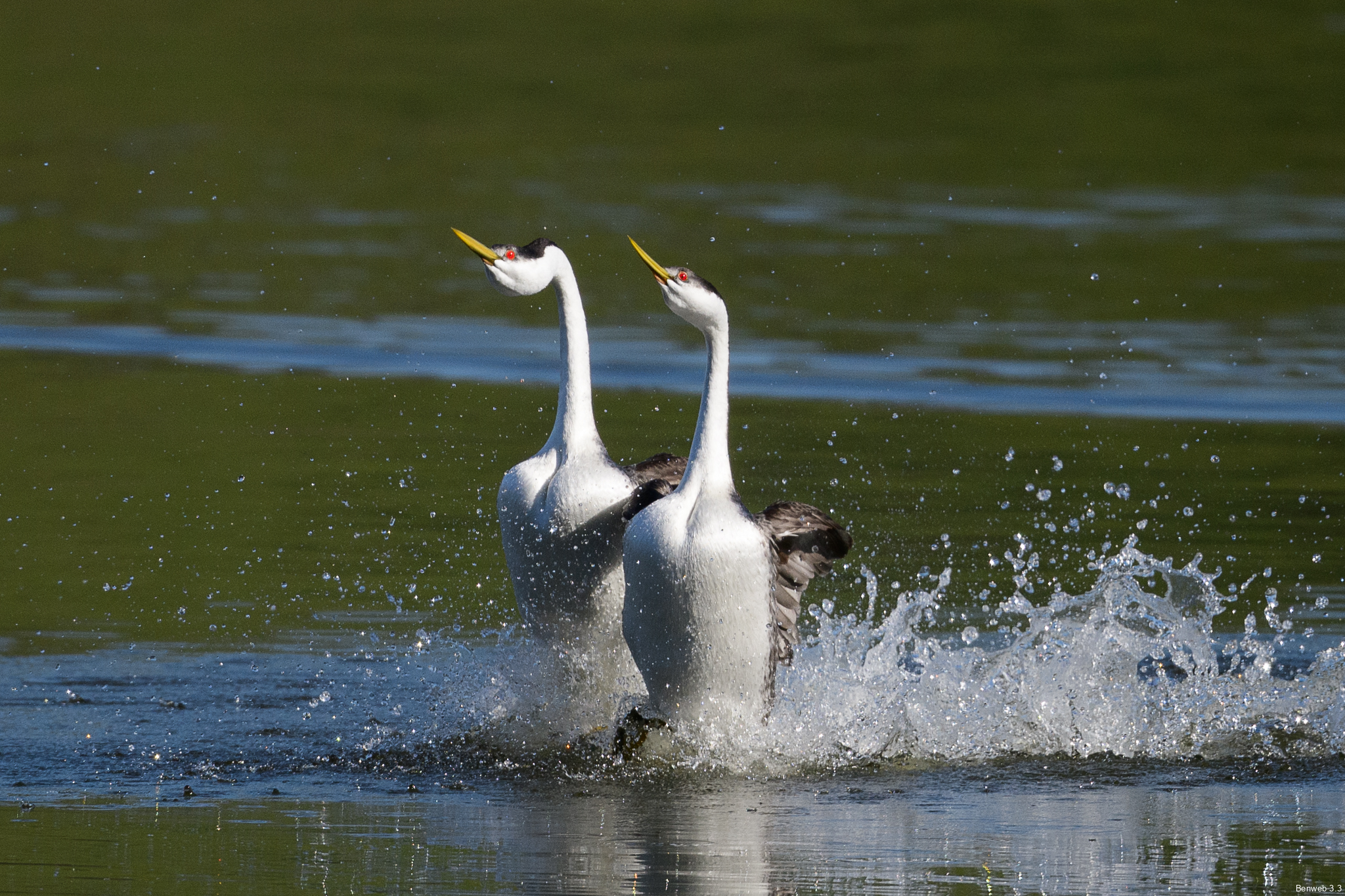
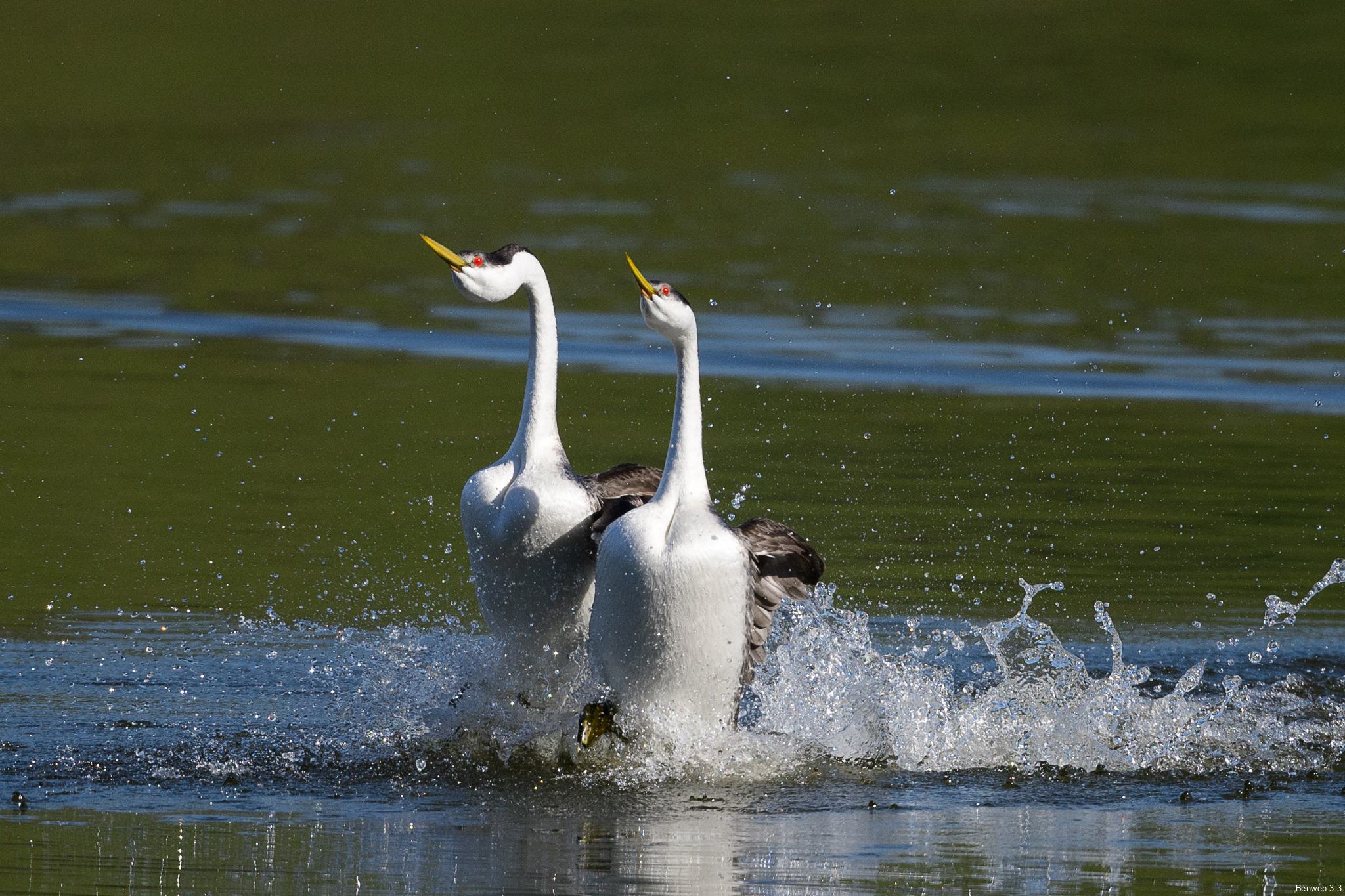
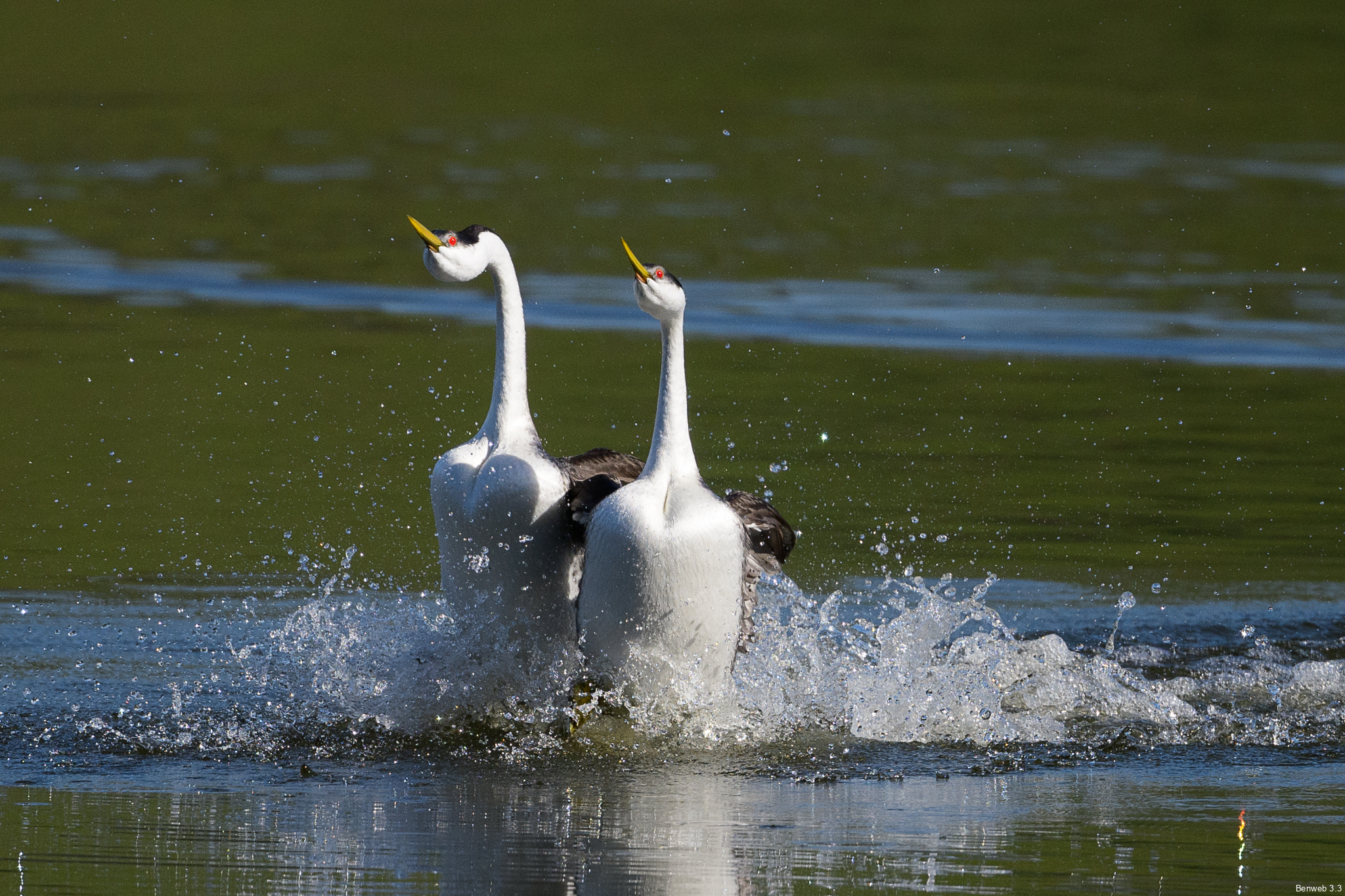
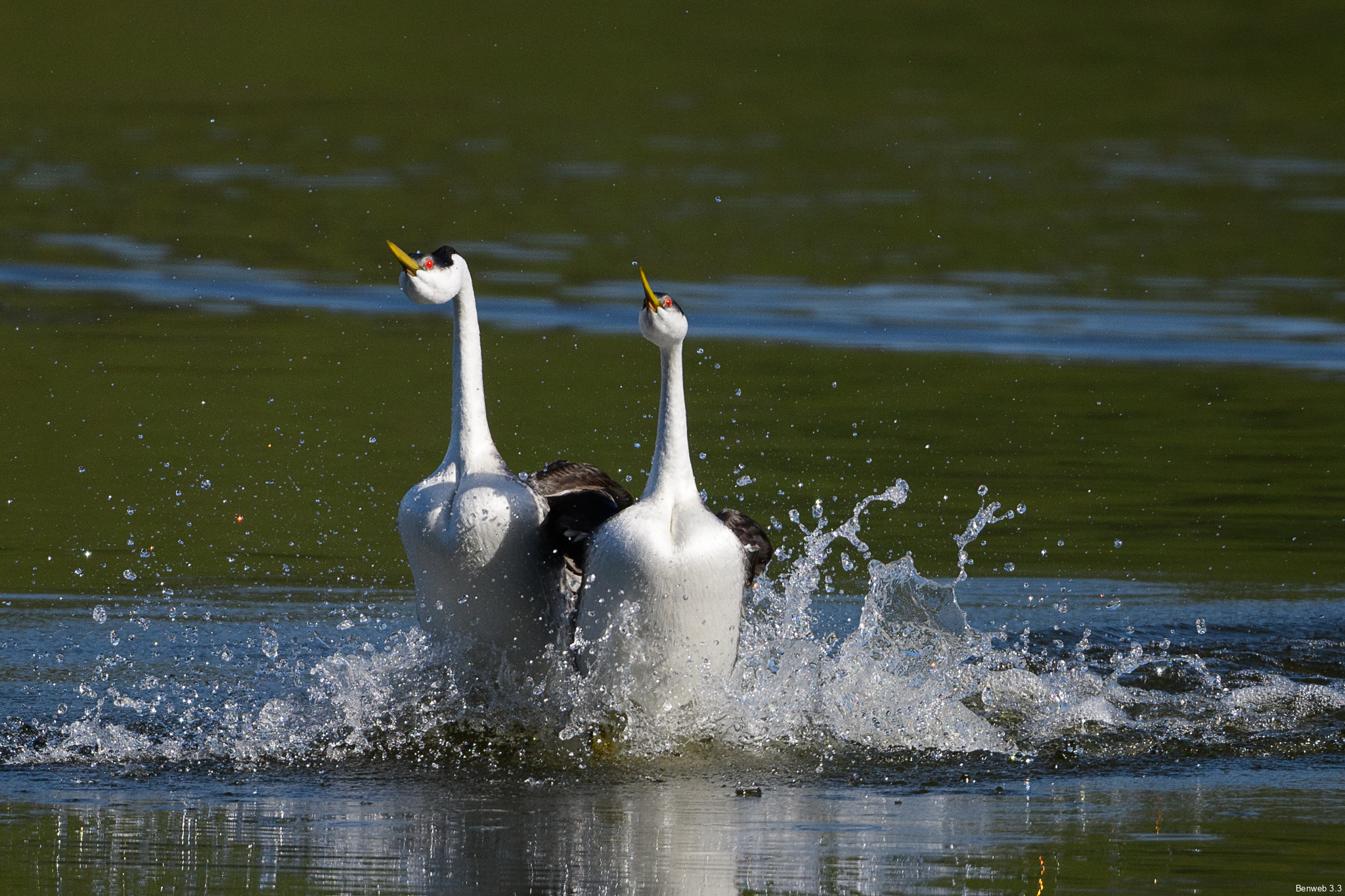
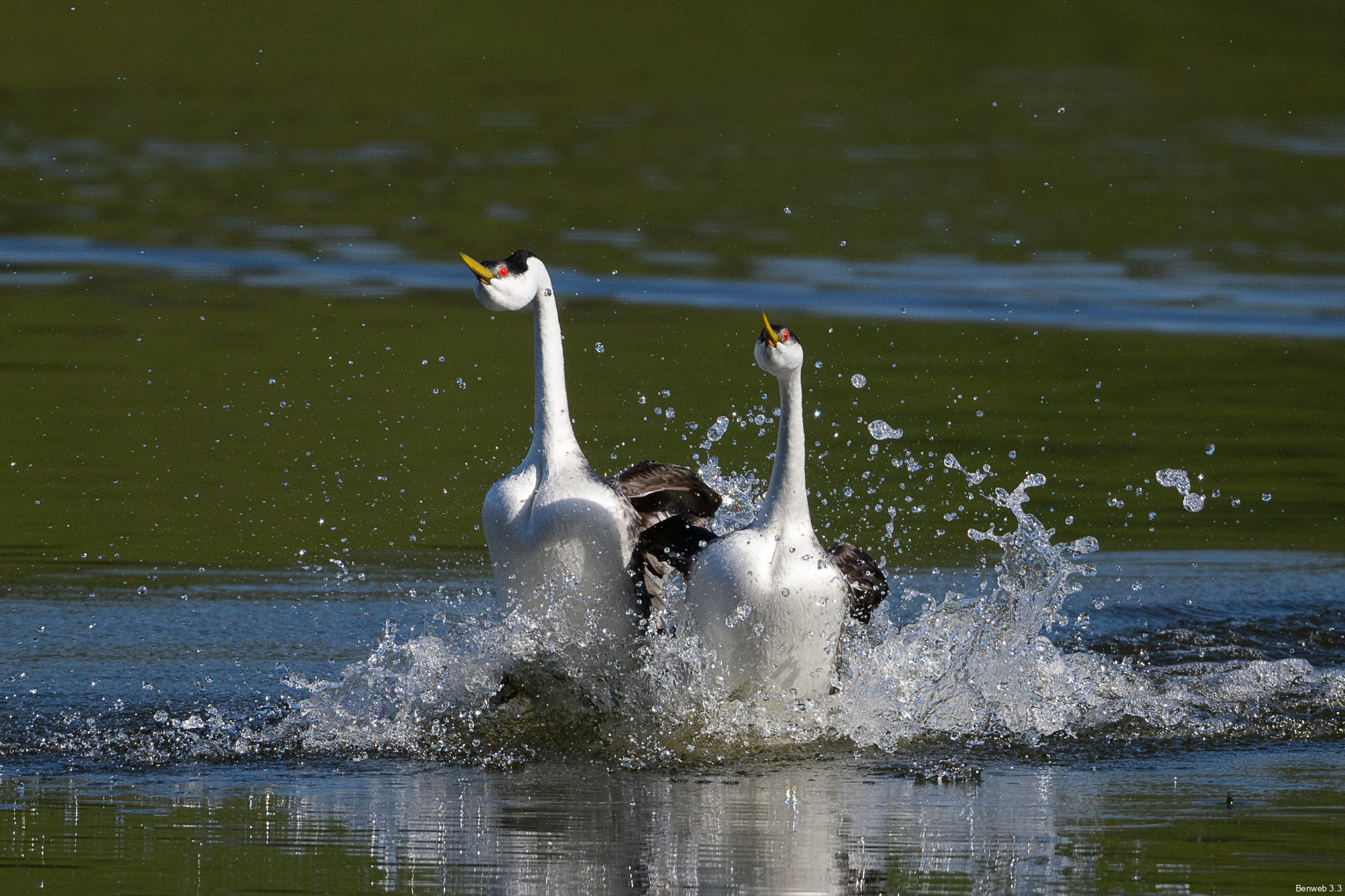
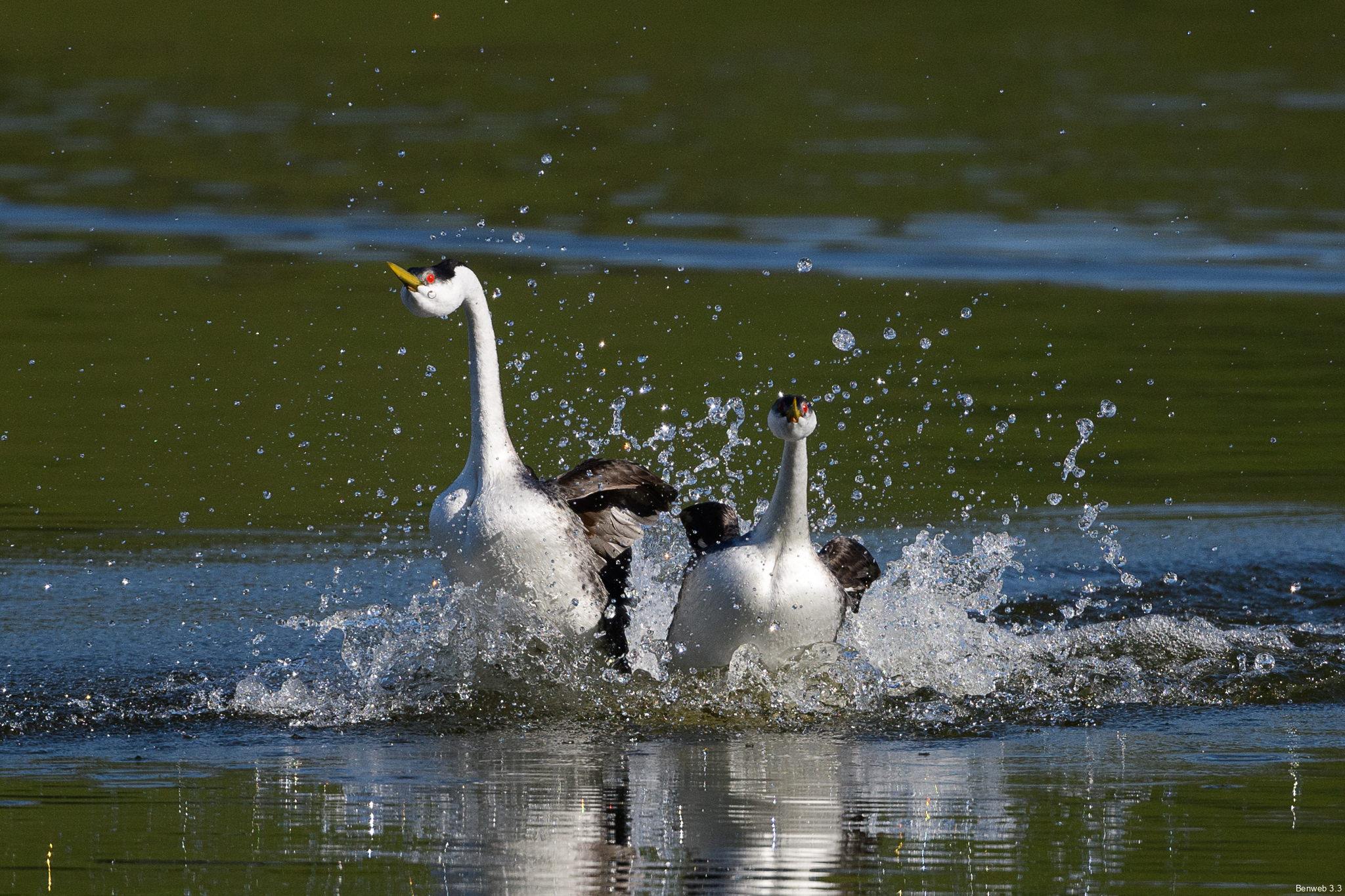
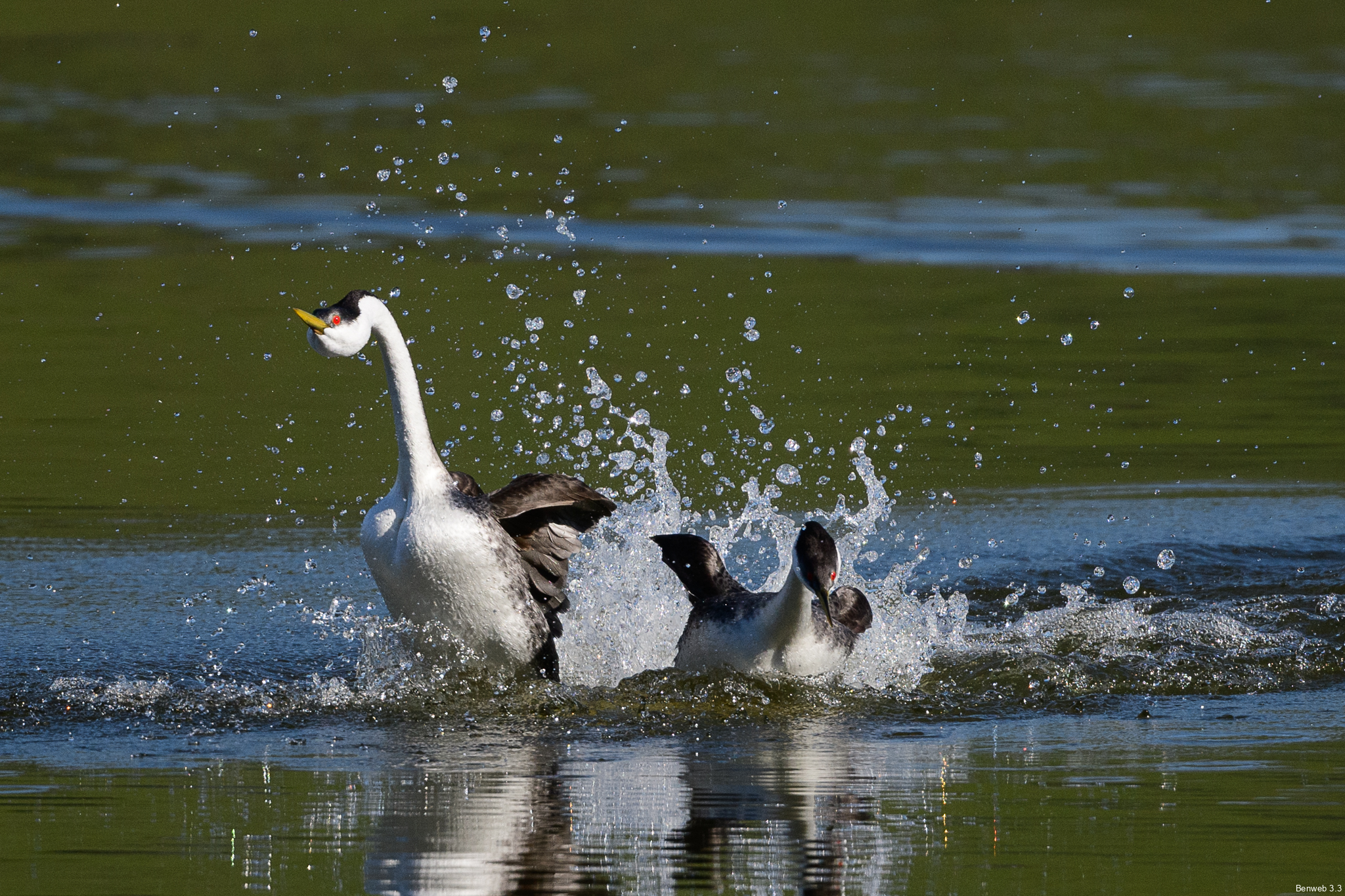
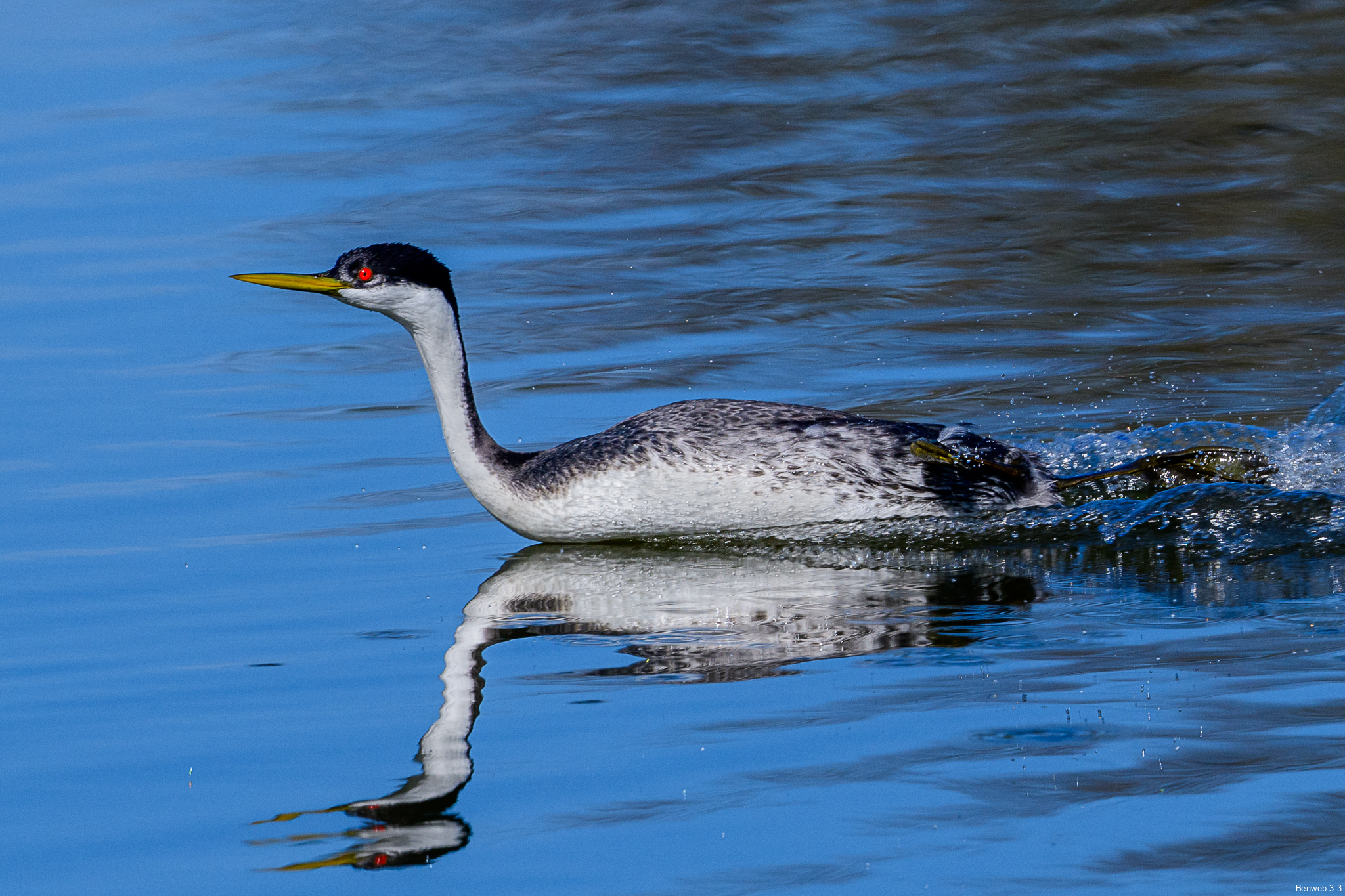
The most exciting behavior both Western and Clark’s grebes perform, and by far their biggest claim to fame, is rushing. They synchronize their movements in a little ramp-up before the rush proper, facing each other with bodies low in the water, alternating little vertical bobs of the head with bouts of synchronized preening. Once they’ve determined that yes, they’re ready to go for it, they lunge simultaneously in one direction and lift their whole bodies vertically out of the water before they run across the surface anywhere from 10 to 70 feet. They’ll do this in pairs if they’ve gotten their signals right, or solo if they haven’t, which I imagine is somewhat embarrassing.
The runs go anywhere from five to twenty meters on top of the water. It’s astonishing to watch these birds, which almost can’t walk, rarely fly, and usually swim at the surface or under the water, break character like this and scamper across the surface of the lake. Apparently it’s quite physically taxing, too, since these rushes last at most a few seconds before one bird or the other dives back down onto the water.
Here’s a pair of Western Grebes rushing. It’s part dance, part speed skating, and very intense.
Usually rushing happens in pairs, but not always. I’m pretty sure this next sequence is an example of what happens when signals get crossed: a Clark’s Grebe goes for a solo rush while a Western Grebe looks on, perhaps bemusedly:
clgr_solo_rush_20260201-1
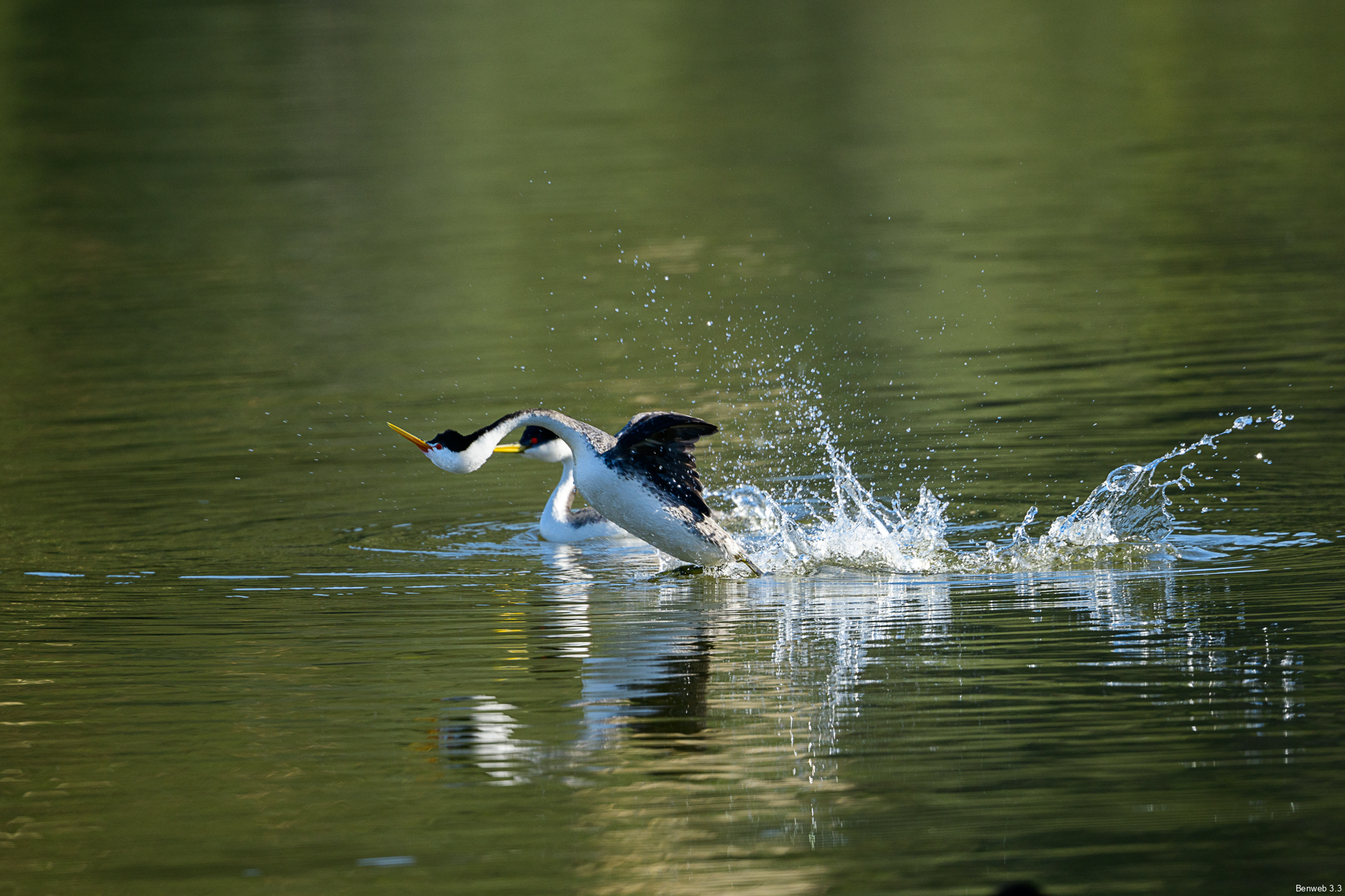
Rushing, or at least speed running on the surface, isn’t just for courtship, either. I watched a Western Grebe rush into a bodysurf to escape from a Clark’s Grebe that was displaying a bit of a temper (biologists call this “agonistic behavior”):
wegr_bodysurf_20260201-2
Weed Ceremony
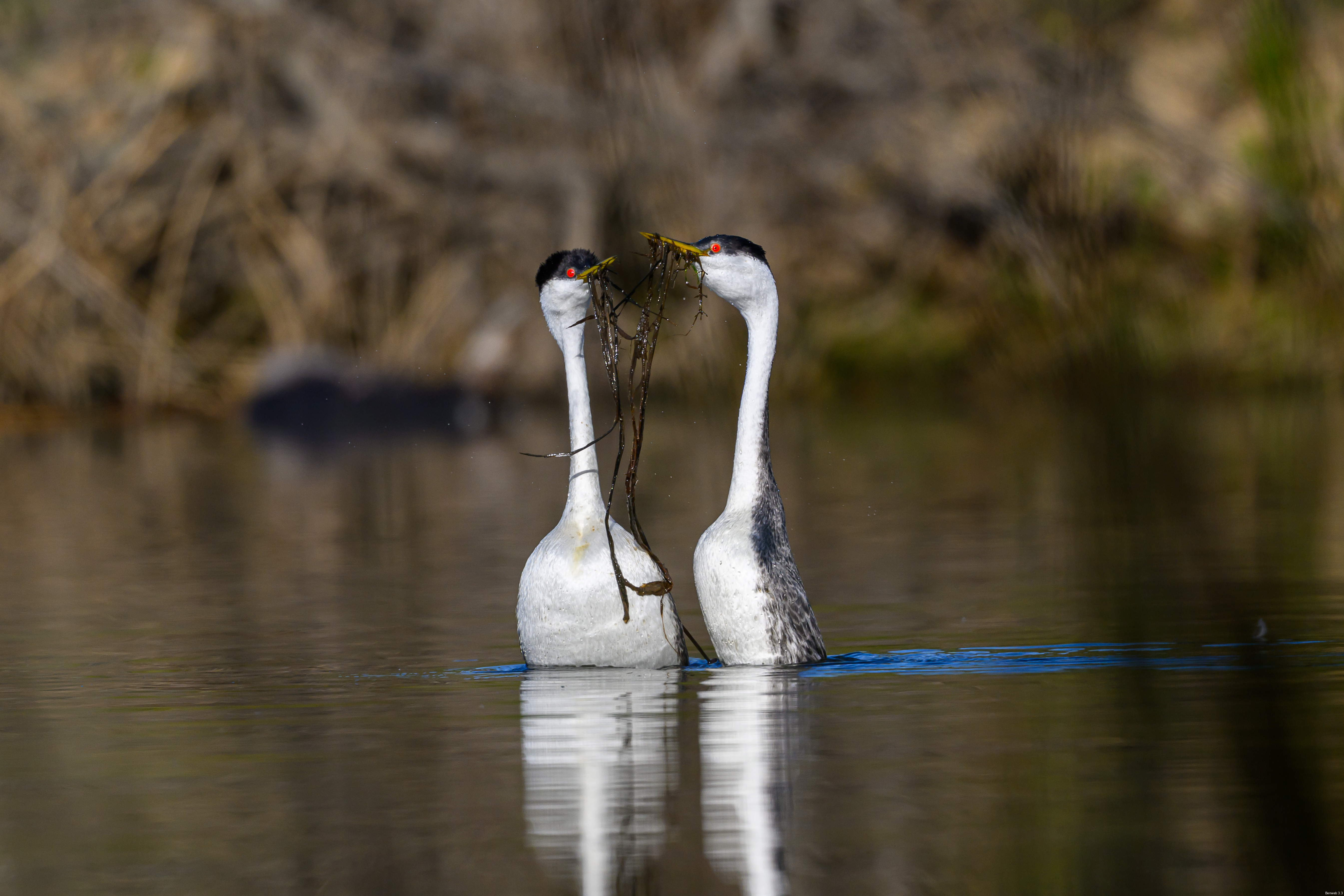
A second aspect of their courtship ritual, which takes place after rushing has formed the initial pair bond, is the weed ceremony. Compared to the rushing, which takes only a few seconds once the birds get going, the weed ceremony is majestically slow. I couldn’t believe my eyes, seeing how still and serene these birds are, practically motionless while they levitate vertically on the water’s surface for minutes at a time. (My photos of one such sequence show that a full minute passes with them “standing up” on the water’s surface the whole time.)
On my second trip to the lake, the grebe collective at Mackey Point had disappeared, presumably with pairs absconding to the other side of the lake. This greatly reduced the number of birds I was able to observe. Around the corner from the point, though, I found a pair that had meandered relatively close to shore. As soon as I spotted them, I hustled out of the truck and threw myself and my camera down into the mud on the lakeshore, hoping to reduce the threat of a standing human profile to the birds. (Sorry about the mud, future laundry me!)
This posture is a good way to get some pictures when you don’t have a blind but you do have birds in front of you, but it is a bit awkward to maintain (and to clean up afterward). I lost track of the birds from time to time as they dove and resurfaced, gliding in and out of view behind some of the rushes on the shoreline. Eventually, though, I noticed the pair “standing up” on the water with weeds in their bills, and I started grabbing pictures. They were in fact performing the slow-motion vertical dance of the weed ceremony, which I’d never witnessed before. (It turns out that their diving in and out of view must have been when they went down to grab the weeds needed for the ceremony. I didn’t figure that out until I got home, though.)
In this dance, as in rushing, the birds appear to levitate on the water’s surface, but unlike the frenzied energy of the rush, the weed dance is a stately slow-motion evolution. The pair start off a little ways apart before they slowly drift closer together, present their offerings to one another, advance and retreat and return, then eventually drop their weeds and return to their normal posture on the water.
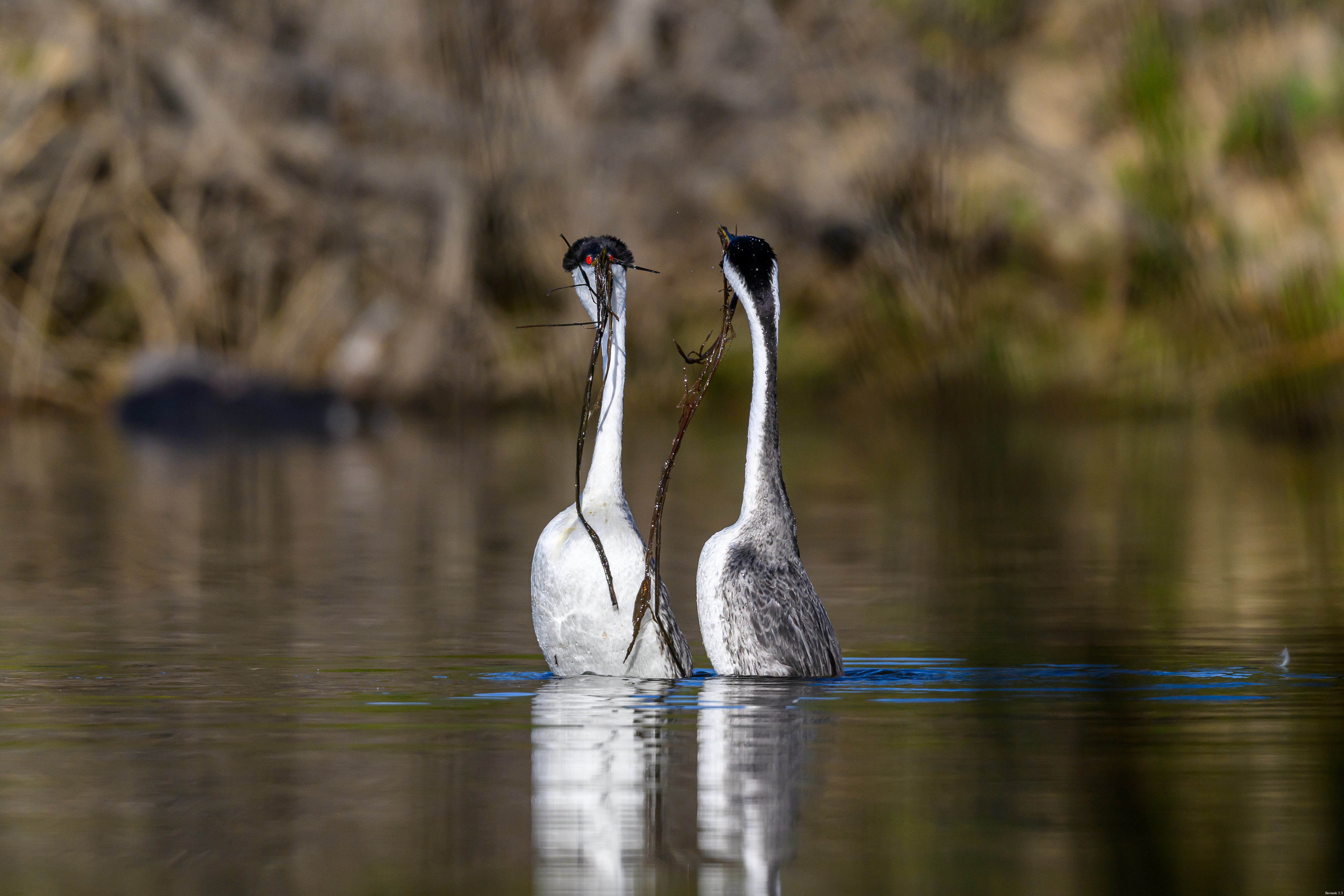
I only managed to get a few aesthetically pleasing shots of this amazing interaction since I was a bit constrained by my posture and the intervening vegetation, but the few that I selected here capture the flavor of the exchange nicely.
I don’t know whether I’ll be able to get back out to the lake before the grebes are done performing these dances for the year, but I’ll certainly try, and if not, I absolutely know that I’m headed back there next year.