On the first day of the 2026 Morro Bay Bird Festival, I found myself with a free morning. I had been scheduled to provide backup support for a local field trip, but it turned out that I was surplus to requirement. So I decided to make good use of the free time and made my way down to where Morro Creek empties out onto the beach to see what I could see. And boy, am I glad I did! Because what awaited me there was one of those moments that birders dream about: a pair of Peregrine Falcons relaxing on the beach!
It’s not at all uncommon to catch a glimpse of peregrines in the vicinity of Morro Rock. They’ve been nesting there for decades–the first known nest in recent years was reported way back in 1967, just a few years before their designation as an endangered species in 1973. (Their recovery took about 25 years–they were delisted back in 1999 as a result of their strong rebound following the phase-out of DDT, which caused disastrous eggshell thinning in numerous species, as chronicled by Rachel Carson.)
As I said, it’s not uncommon to catch a sighting of one, and I always enjoy it when I do, but… They’re usually extremely far away, and they’re always hard to approach. My typical sighting involves a distant bird sitting in a transmission tower, seen through a spotting scope, or perhaps a spotting-scope view of one perched high up on Morro Rock, or binocular views of one or even several soaring above it. But that morning was the first time I managed to get a bit more intimate look.
Usually when I go to Morro Strand a few hours after dawn, it’s pretty crowded with strollers, dogs, strollers with dogs, and kids who love nothing better than to run through a lounging flock of gulls right when I spot the interesting Herring Gull among dozens of Westerns and Californias. That morning, though, there weren’t any dogs, and there were really only a few other people on the beach. There was a smattering of gulls lounging in the creek mouth, along with a lone Long-billed Curlew. And, shockingly, a pair of peregrines just sitting (well, standing) on the sand. They were relaxed, and I suppose that’s why they permitted a relatively close approach. (At no point was I closer than about 50 yards; as soon as I felt them starting to look at me and change their posture, I stopped and backed up a bit. It was still many times closer than I normally can get to these birds.)
From time to time one or the other would just lazily fly over the heads of the nearby gulls (and that one lone curlew). It didn’t look like they were trying to catch them; they were just enjoying the morning and having a little fun while stretching their wings. (The gulls and curlews weren’t quite as blasé about it as the falcons seemed to be.) One of the falcons even took advantage of the flight time to scratch at an annoying itch on its throat.
peregrine_pairlanding_20260115-1
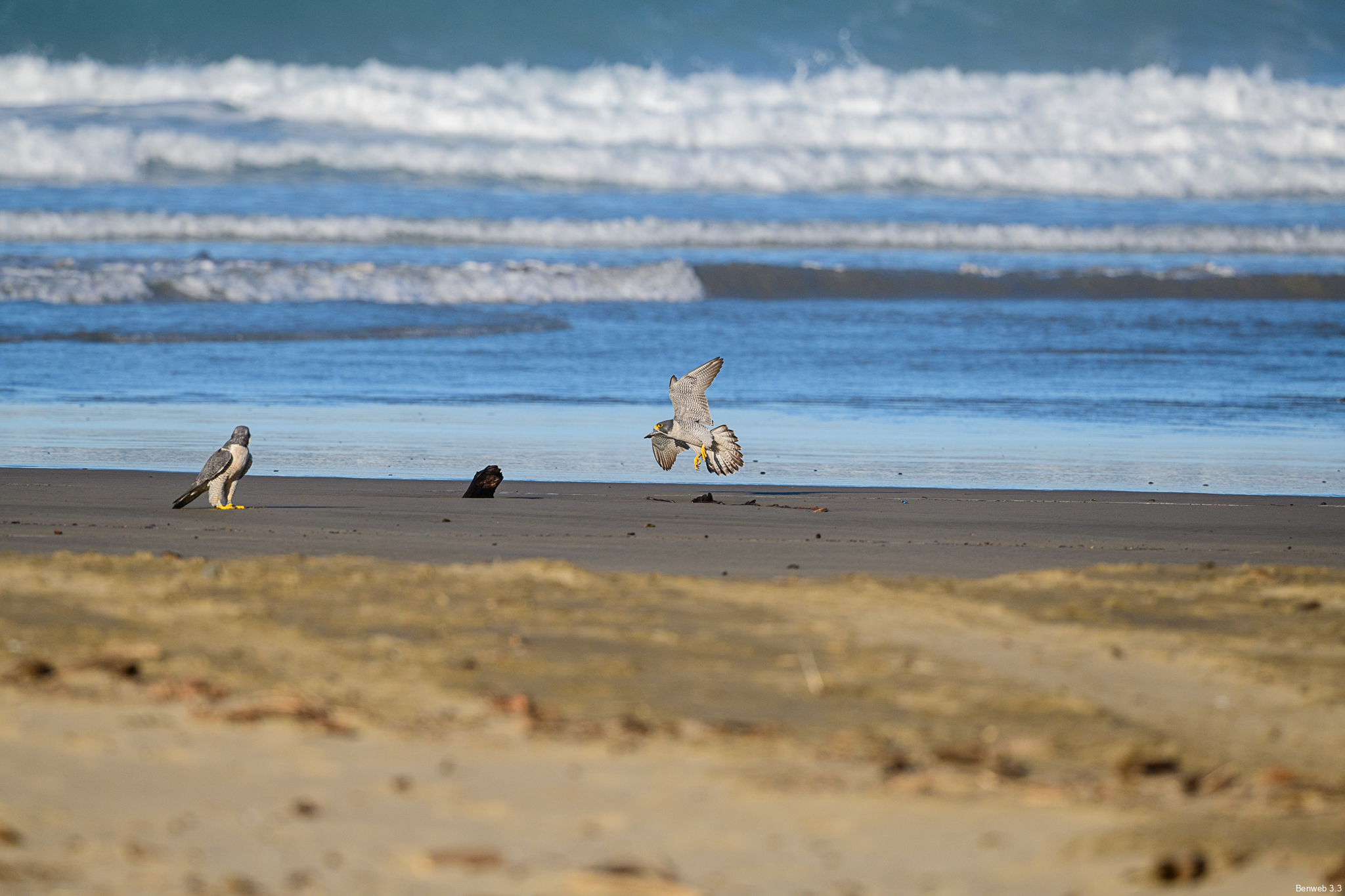
All told, I spent about 10 minutes watching them take turns going for short flights over the waves, landing relatively near one another, and basically just enjoying their morning the way I was enjoying mine. Then they either got bored or decided that they no longer wanted to perform for their appreciative papparazzo, so they took off and flew back over to Morro Rock.
When I eventually got the pictures “developed” (downloaded to my laptop and sorted), I was amazed to see an important feature that I hadn’t noticed while in the field: one of these birds was banded! That meant we have some life history for the bird, which is a rare chance too enticing to pass up!
I sent a few pictures of the banded bird to Steve Schubert, who literally wrote the book on the 50-year history of peregrines at Morro Rock (covering the years from 1967 to 2017), and he suspected that it might be the local breeding female, nicknamed Sierra. She’s been breeding on the north side of the rock for at least a decade. He checked in with Bob and Jerry of Pacific Coast Peregrine Watch, who confirmed that the bird was indeed Sierra, banded as a chick in 2012 about 100 miles up the coast at Elkorn Slough (112 straight-line flight, 139 miles up Highway 1, which just recently reopened).
Apparently there are two pairs of nesting falcons at the rock, but Sierra is the only one with a band. She was first documented as the north-side breeding female back in 2015, when she was 3 years old.
Terminological side note: male falcons (and hawks and eagles) are called tiercels; females are called formels.