One of the most familiar spiders to Florida residents is the spiny orb weaver, Gasteracantha cancriformis. You’ll see people flailing their arms wildly after running into their webs all the time. This actually happened a lot at our old house, because these little guys make fairly large webs, and they loved to decorate our front porch back at the old house. They were so abundant in the fall that I’m tempted to call it our halloween spider; they might as well have been our trick-or-treat decorations.
This fall, though, at the new place, they’re a bit more scarce, although that might change soon, as you’ll discover after reading this post. Just this morning I ran into one web while I was trimming the ficus hedge our next-door neighbor so thoughtfully installed between our two properties:
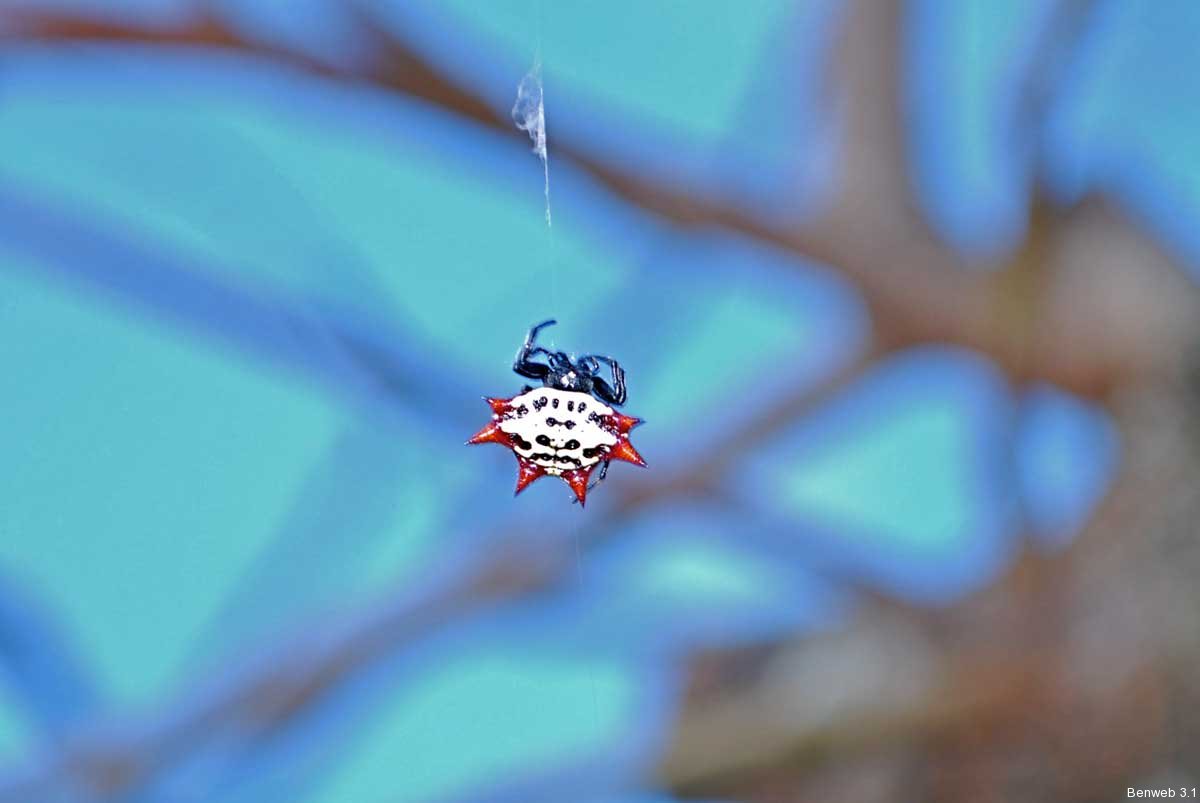
As you can see, it’s black and white and red all over. That is, the dorsal portion of the abdomen is white with black spots, and there are eight red spines projecting out rather threateningly. Local folks (myself included) often call this a “crab spider,” even though it’s really not related to the crab spider group (Thomisidae).
Gasteracantha is an Old World pantropical genus; G. cancriformis is the only member of the group to occur in the Americas, where it is widely distributed, ranging from the southern states to Argentina.
While all spiders are venomous, the bite of this species, despite its fearsome (if diminutive) appearance, is not known to cause serious [i.e., lethal] effects in humans.
The reason I’m posting about it today, after years of neglect, is that I finally ran across an egg sac and dozens upon dozens of spiderlets. As I said, I was trimming the ficus hedge (our neighbor’s yard crew trims her side of the hedge, but our side, even though I’d rather burn the hedge down, is up to me to tend), and this little bit of garden work brought me into contact both with the adult web (which extended down from our Royal Poinciana tree into the hedge I was working on) and, I later discovered, the yellow egg sac.
Here’s a shot of the egg sac:
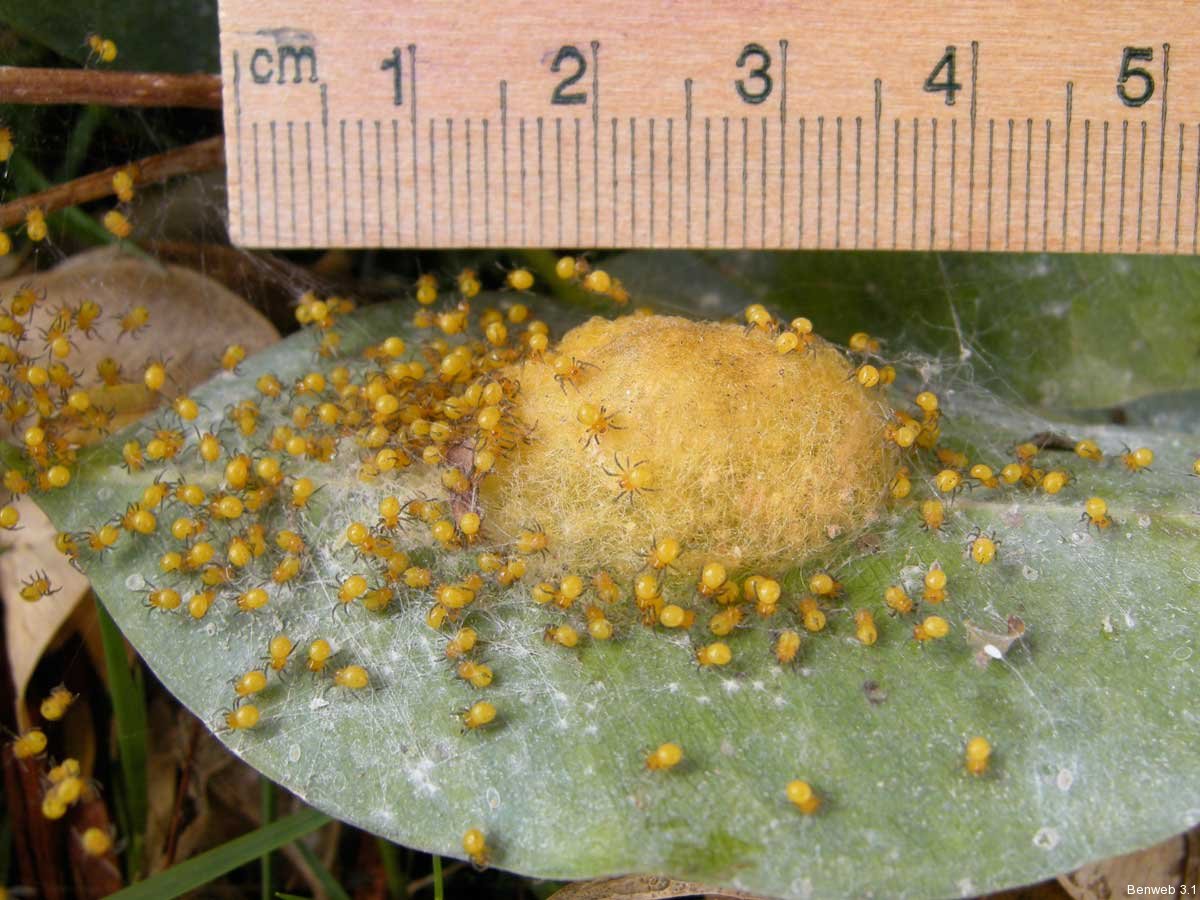
It’s about an inch long (25 mm) and slightly less than that wide (15 mm). You can see all the spiderlets crawling all over it; there must be a couple hundred of them! I took a brief video of it, if you’re interested:
I’m not entirely sure that this is a “crab spider” hatch-out, but I haven’t seen many other orb weavers around here. The folks at bugguide.net haven’t nailed down an ID for me yet, but they do seem to think that this might not be G. cancriformis after all.
If it is (and even if it isn’t), the etymology of the spiny orb weaver is refreshingly uncomplicated: Gaster is Greek for belly, of course, while acantha is Greek for horn; cancer is the Latin version of crab, and form is, well, our latinate word form. So this is the horn-bellied (or abdomened) crab-shaped animal. Hooray!
Hi,
I have this exact same egg mass and hatching in my East West Palm. I found it yesterday and today when I looked again the spiderlets were coming out. The thing is – I am in Brisbane Australia!!
Did you confirm what sort of spider they are?? The tree is close to our house – so I wouldn’t want 100’s of poisonous spiders coming inside!
Please let me know – this is genuine – I have the pictures on my phone.
Thank you Susie 🙂
By the way it was hanging from a palm flower branch – attached with fine white threads – we thought it was a silk worn cocoon but after I saw all the spiderlets this morning obviously we’re wrong !! Thanks again Susie
I found it! It is a golden orb-weaving spiders (Nephila edulis) http://museumvictoria.com.au/about/mv-blog/categories/melbourne-museum/ look half way down the page! Thanks S
Hi, Susie.
Glad you were able to find your spider! Based on your research, I could guess that the one in my yard is our common N. American golden silk orb-weaver, Nephila clavipes. Only thing is, I haven’t seen any on this property, and they’re so conspicuous I doubt I’d have overlooked them. Their webs are gigantic, and they themselves are about the biggest spider most people ever see…
just finally moved into our new home in st. augustine, fl about 10 days ago and found at least 50 org weaver spiders in my screened in pool area. Are they poisonous? How should i remove them?
Hi, Rebecca.
All spiders are venomous but very few can do more than annoy. Many, in fact, have fangs too small even to pierce human skin. Some of the larger orb weavers can bite, though. I’d recommend a broom to sweep them outside. Pesticides around a pool are bad news. Do you know what species of orb weaver you have?
–Ben
I am curious why you say pesticides around the pool are bad news. What do you mean by that?
Well, we swim in a pool. We absorb chemicals through our skin. I’m not sure that the chlorine in the pool breaks down pesticides in anything like a safe manner. But it’s not something I’ve studied or researched.
Is there a reason to want to swim in a pool that’s full of pesticides? Or some research out there that shows that pesticides break down harmlessly in a typical swimming pool environment?
I would NOT spray these spiders. They kill many gnats,flies and mosquitoes and are beneficial. In fact, they are one of the best ways to control mosquitoes which carry diseases such as West Nile virus. The Star Spiders like to build orb webs in trees or bushes and are not harmful to people. But they collectively they can kill millions of mosquitoes over time. They are one of the best natural biological control agents for mosquito control. Actually we should be mass rearing these spiders and releasing them to control mosquitoes as diseases like West Nile virus can kill people such that these spiders are actually saving people’s lives!
Visit Spiders and Flies at byteland.org/spidersandflies/index.html where I have posted photos of Gasteracantha cancriformis, aka the Star Spider or Crab-like Spiny Orb Weaver
Thanks, Dr. TAL.
I have no plans whatsoever to spray these spiders; I like having them around. I remove their webs when they’re blocking a walkway, but other than that, all are welcome here. Thanks for the link to your site; interesting stuff.
Thanks for saying that!! Too many people automatically kill our spiders. They are useful critters!!!
are they poisionios???????
All spiders are venomous, but I’ve never heard of anyone suffering from ill effects of this spider’s bite. Its fangs aren’t too large and its venom is not very potent. This is not considered a dangerous spider.
Are the orb spiders with the red horns/spikes dangerous to my avocado tree … I found some on the leaves and I am concerned ..please help!!!
No, these spiders are at worst neutral, and perhaps beneficial, to your avocado tree. They don’t bite people and they eat insects that might damage the tree. (They also might eat beneficial insects, too, but never too many.)
I’m in the Upper Keys (FL) , where gasteracantha cancriformis is very common in late fall and early winter. I don’t bother them except when they festoon our 3 lignum vitae trees, especially when they’re in bloom, and catch honey bees attracted to the nectar. I knock down their webs with a broom, don’t kill them— they’re annoyingly quick to weave new webs.
Thanks Ben! I really enjoyed your video and commentary, it made me smile. And it’s always nice to see people helping others and sharing knowledge for no other reason then to share 🙂 what exactly is your profession? Well I hope you have a great one.
Thanks, Jessica. I work in publishing; nature is where I go to keep it real. Cheers!
l found a spider in my back yard that looks very similar, but I only see four red spikes on his sides and his body is bright green where the white should be. His web is huge. What do you think? A cousin, maybe?
We have one of these in are blackberry bush- Mom actually got caught in it’s web! It looks a little freaky, so I can understand why a lot of people probably wouldn’t want to go near it. I actually think its kind of cute, but that’s just me. I’d
probably say a Brazilian wandering spider was cute if I didn’t know it was extremely venomous.
Hi Ben! I have a red ,light green ,white and black spider on my avocado tree and looks exactly like the picture above , all it does is spin humongous webs and eat bugs also it is starting to freak me out ,should I be worried!
What part of the country are you in? I’m not sure what spider you might have, but it’s good to remember that, for the most part, large spiders are not particularly dangerous. (Even the tarantulas are more scary than dangerous.) You’re not describing anything like the really dangerous spiders in North America (the widows or the brown recluse), so if I were you I’d just let it be.
Hello to all….we are 20 miles south of New Orleans on the bayou in Crown Point. We moved down here 13 years ago, this was the first year I’ve seen the same type of spiders. We have yellow ones and white ones. After close observation (we put one of each in a jar and watched them) we found that the white spider lays neon green eggs. We are now waiting for our eggs hatch. I’ve been doing a lot of resurch on these beautiful yet crazy looking things, seems like they are not going to harm us so I’m not going to go on a killing spree. I think I will keep them around since we can use all the help we can get when it comes to sketer control.—–Steph G.
I picked up this little feller up and let him run across my hand WRONG thing to do everyone .My pinkey is swollen for two days now with alot of pain …….Bob
Hi!
I have just moved to Florida have about 4 of these spiders inside my pool enclosure. The ines I have are a yellow/green color with red spines.. I love all creatures, however I don’t want these four (females I think) to lay 100 eggs each.
My pool enclosure is mesh, so no insects can get in, therefore they won’t really be getting food other than a few microscopic flies….
Due to them being in my enclosed pool area, I don’t want 400 babies to mature, then cover my whole pool enclosure in their magnificent webs!!
I was happy to leave them but now I realize they are about to reproduce in the spring time, I want to move them outside my pool area, have you any advice on how to do this?
Thanks in advance,
Chris
They bite. and it hurts. from http://wiki.answers.com/Q/Are_Gasteracantha_Cancriformis_poisonous “The gasteracantha cancriformis is a type of spider known by many different names including spiny orb weaver, jewel spider, and smiley face spider. The bite of this spider causes a burning sensation that is often described like that of a fire ant bite. However, besides the burning sensation the bite is not dangerous in any other way for most people.”
They bite. you probably won’t die or lose muscle tissue, but it might hurt. cause a bump. think I got bit by one two-three nights ago. from http://wiki.answers.com/Q/Are_Gasteracan… “The gasteracantha cancriformis is a type of spider known by many different names including spiny orb weaver, jewel spider, and smiley face spider. The bite of this spider causes a burning sensation that is often described like that of a fire ant bite. However, besides the burning sensation the bite is not dangerous in any other way for most people.” So hey, no problem, right?
Methinks people who claim they are harmless have never been bit by one. play with one until it bites you and then report back. think aftermath of a good fire ant bite. a bump, maybe some puss, hurts like hell.
also see robert’s answer above which I have reproduced below.
December 17, 2013 at 5:38 am • Reply
“I picked up this little feller up and let him run across my hand WRONG thing to do everyone .My pinkey is swollen for two days now with alot of pain …….Bob”
R
I have a couple of these spiny orb weavers inside my pool screening. they are the white/black ones with red spikes. I was bit on the calf by one of these I believe and I now have 2 holes that have formed where the bite was. idk how or why but it has cause serious pain and walking isn’t the easiest. any information would be helpful as I dislike the hospitals and would rather care for myself unless seriously needed. thank you.
I got caught up in a web last Friday evening. It shocked me, and I fought to get out of it. I didn’t think the spider got on me or bit me, but around midnight I started having fever, sore throat and neck/head ache. This lasted most of the night. By morning time all was well except the headache, which was hanging around a bit. Saturday evening I went out to a barbeque with my husband. I crossed my arms and placed my left palm on my arm above my right elbow. The skin felt very hot, and when I looked at it the color was purplish red and about the size of a playing card. The area was also slightly itchy. I couldn’t think of anytime I had been bit by anything, until on the way home when I thought about getting caught up in the spider web. When we got home, I went to look at the web again. It was all repaired, and in the center was a white spider with black markings and 6 black spikes…2 from one end and 2 on each side. I looked on the internet and found that it was a spinyback orb weaver. The article reported it to be a venomous creature, but that it couldn’t bite a human. Well, let me tell you that something has torn me up. I can’t think of anything else it could be. It is now Monday, and the red area has almost circled the area above the elbow, and a new red blotch has occurred below my elbow. I went to the urgent care physician yesterday, and he put me on antibiotics in order to keep any infection down. I am wondering if anyone else has had such a reaction?
Found the Yellow Body with Black dots on my back porch next to my pool. Walked into the web, and pretty well decimated it. However, the spider did not try to bite me, but rebuilt the web even bigger by the next day (even though a little higher up than before). Interesting that they are native to Columbia. Must have come over with some of those special Colombian crops from a ship docked in Mobile Bay.
I have one of these spiders that appeared in late October or early November, 2014 and is still here in the middle of March, 2015. I was sure she was gone a couple of times when we had frost for days in a row and some heavy storms, but she always reappeared and built another web using a Rosemary bush in a flower box as a lower anchor and the soffit and posts of the small porch overhang on the front patio as lateral and upper anchors. Hence, I question the several articles I have read which characterize the species as being short-lived because this spider is still vigorous after 5 months of often less than optimal weather conditions.
I’ve been bitten twice by this spider. Once in my yard in Florida, it caused a large (1 x2″) itchy bump on my arm that recurred after three months and again a year later, the bump lasting a week or two each time.
Again in Hawaii I walked into a web leaving a huge (1 x2″) itchy bump under my left eye that returned a year later, again lasting a week or two. My doctor just shrugs. He has no idea why the bites recurred
I am 31 & lived in Florida all of my life. I have moved several times, and the “crab spider” has been at every residence but one. My daughter and I actually collect them, by hand, and put them in our yard. I have probably held hundreds and have never been bitten. I have walked into webs countless times, and have never been bitten. I found 7 adult spiders at a local park last fall, closed them in the palm of my hand and walked a block with them to release them at our house. Not only was I not bitten, but I am happy to report we now have baby crab spiders making their homes in our trees all over the yard and even in our atrium. My daughter plays with them, as well. We think of them as our pets and natural pest control and protect them from guests who may not feel the same way as well as the pest control tech. They are great. If they creep you out, wind their web around a broom handle, spider attached, and brace against a tree.
Thanks for sharing! I’ve never yet had a problem with these guys, after years and years of living with them. Every now and then I have to pull some web out of my hair or off my arms because I forgot to look where I was going, but that’s all.
These pictures ALMOST look the small spiders I’ ve seen at my house in Jupiter (So. Florida east coast, just at the top of Palm Beach county). Mine are small – and have a yellow belly with red veins, and quite a tough and large Web compared to the spider itself, which is less than a half inch.
I don’t like spiders in general, and I have m learned to check on bugs before I dispose of them. If they are beneficial to my yard or garden, I will just stay away from the creepy ones.
Has anyone seen SMALL spiders like this, with a yellow belly, not white. Wish I could post a l photo…
Yes have seen the yellow ones here in Melbourne, FL while working in the yard… tried taking photo with camera without success; camera would not focus onto spider. Googled ‘strange looking spiders in Florida’ and went from there!
I have been bitten on the leg twice by the same spider. It has swollen turned red and burns. In the middle of the bite is a small white puss pocket. Should I go get antibiotics. I live in St Petersburg FL and work on pools for a living. This is the first time one has bitten me. Any help or suggestions.
I’m not a doctor, so I can’t offer qualified medical advice. My understanding is that spider venom is not bacterial, so antibiotics would have no effect as an antivenom. If there appear to be signs of a secondary bacterial infection, antibiotics might be helpful.
I found one of these today . And was scared but when I looked it up I just left it on my front porch . As we live in south (alabama) and have many mosquitos. It was beautiful…
Last year I found The key West crab spider or as people call it around here the garbage spider, is creepy. It spins it’s webs in my enclosure by my pool. I don’t like them, so I knock them down and kill them. I did find yellow sacks knocked them down and threw them away. They stopped multiplying. They just came back, oh man.
I have one in the foliage by the front door. Catches massive amounts of mosquitoes that would otherwise be after humans. We named him Scaredy Face.